Category Archives: Business & Economy

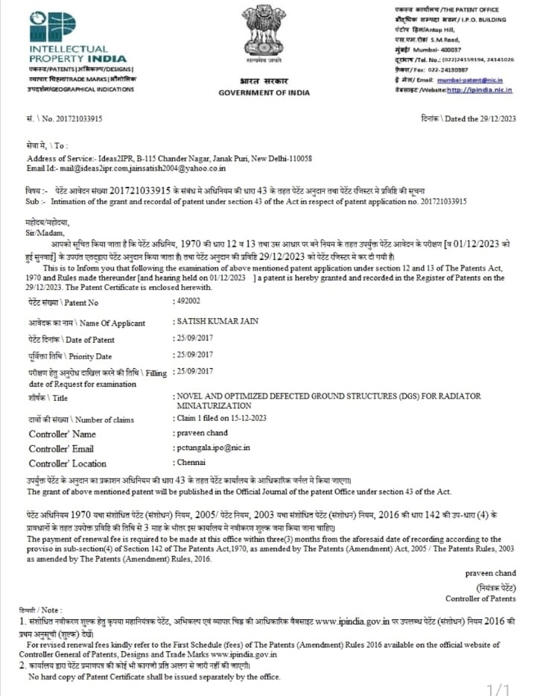
NATIONAL: PATENT: Madhya Pradesh’s Science & Innovation: SGSITS’s Professor Satish Jain Created ‘Radiator Miniaturization’ To Be Used By ISRO, DRDO

Government of India recognized and granted the patent for the invention of ‘Noble and Optimized-Effective Ground Structural for Radiator Miniaturization’ created by Shri Govindram Seksaria Institute of Technology and Science (SGSITS) professor Satish Jain. He registered a patent for the same.

“I have reduced the size of the antenna to be installed on the nano satellite,” Jain said. He added that due to this, the quality of the satellite will improve.

“This has become possible after my hard work of the last 7 years,” Jain said. The invention is expected to be useful for the sky related satellite activities of the Government of India (Indian Space Satellite Research Center ISRO, DRDO)!

“Due to the smaller size of the antenna, the possibility of expanding the service by installing more modules in the satellite increases,” Jain said.

Director of the institute Rakesh Saxena said, “Nano satellite is a small satellite platform with very high density technology, which must use reliable design.” The invention can help in reliable and efficient nano satellites, he added.

source/content: freepressjournal.in (headline edited)

NATION: The Great Indian Startup Shift : 2023’s Lessons and 2024’s Promise

With over $20 billion of dry powder awaiting deployment, the stage is set for a revival of India’s startup ecosystem, with sectors such as AI, fintech and EV poised to lead the resurgence.

India’s startup ecosystem has undergone a transformative journey this year. This shift, while tremendously challenging, ushered in a period of strategic reassessment and realignment for both startups and investors. 

Amid an extended funding winter, desperate pivots, governance lapses, and layoffs, investors have lined up about $20 billion in dry powder–capital waiting to be deployed in startups. 

That brings us to a pivotal question: How will this capital and emerging tech trends reshape the startup ecosystem in the coming year? To attempt an answer to that, we need to have a quick glance into the rearview mirror.

A year of reassessment and realignment

The story of 2023 began with a sobering wake-up call. Venture capital, the lifeblood of startups, receded dramatically from its zenith of $35 billion in 2021 to $8 billion in 2023. This wasn’t merely a financial fluctuation; it was a seismic shift in investor sentiment, mirroring a global trend of cautious retrenchment.

This set the stage for entrepreneurs to pivot, seeking resilience and innovation in the face of adversity. Despite the funding chill, a few startups, including Zepto and Perfios, demonstrated agility and vision, securing significant investments and propelling to unicorn status.

The investor’s calculated manoeuvre

For investors, 2023 was a tale of recalibration. With late-stage funding plummeting by over 73% to $4.2 billion, their focus shifted to a more measured approach and early-stage players, valuing sustainable business models over rapid growth. The perseverance of certain sectors, particularly fintech, which garnered $2.1 billion in funding, highlighted areas of continued investor interest.

Venture debt: A rising star

Amid this capital conundrum, venture debt emerged as a strategic partner for entrepreneurs. While VC investments retracted, venture debt in India witnessed a modest yet meaningful uptick. 

The average deal size, which had once soared to ₹45-50 crore, now mostly hovered at around ₹25 crore. This recalibration wasn’t merely numerical but strategic–a pivot towards robust business models, away from the regulatory quagmires. 

Venture debt, traditionally a side actor, took centrestage, offering critical support to startups, especially in sectors ripe with innovation such as electric vehicles and companies heavy on research and development.

The ecosystem’s resilient response

The year 2023 was one of reckoning for sectors such as edtech and healthtech. The overestimation of the target addressable market for digital education and teleconsultation services, plus governance lapses, amplified by market dynamics were vital learnings and tests of resilience for the ecosystem. 

The Indian startup ecosystem, globally the third-largest, navigated these challenges by pivoting towards high-quality revenue. Bengaluru, New Delhi, and Mumbai, as the epicentres, continued to foster innovation despite the slowdown in unicorn creation. 

The ecosystem’s response was not just reactive but proactive, with the government investing in infrastructure and pushing growth-oriented policies, maintaining India’s stature as a significant technology hub. Startups must continue to navigate this constrained funding environment, focusing on corporate governance and robust margin improvements.

Mega deals resurface

The valuation landscape of 2023 was akin to navigating through a foggy sea. Startups, in the absence of clear valuation benchmarks, turned to convertible notes and flat rounds (raising funds at the same valuations as earlier), buying time in the hope of fairer weather.

As 2023 nears its end, a flicker of optimism has sparked in the form of mega deals. High-profile investments in companies like Perfios and PhonePe have rekindled hopes. The artificial intelligence and EV sectors, along with vertical software-as-a-service, emerged as the new darlings of investors, signalling a market ripe for a rebound. 

We witnessed e-commerce continuing its steady sail, undeterred by the market disruption. This resurgence wasn’t confined to equity alone; the financial services sector witnessed a remarkable surge in debt funding, heralding a more mature and diverse ecosystem preparing for a spate of IPOs in FY2024-25.

The road ahead: 2024 and beyond

Looking to 2024, the startup ecosystem stands on the cusp of transformation. With over $20 billion of dry powder awaiting deployment, the stage is set for a potential revival. Sectors such as AI, fintech and EVs, buoyed by investor interest and government support, are poised to lead this resurgence. 

For entrepreneurs, the path forward involves balancing innovation with financial prudence, while investors are expected to continue their judicious allocation, focusing on startups with long-term viability. 

Meanwhile, venture debt is anticipated to play an increasingly significant role, offering a lifeline to startups navigating the intricate balance of growth and sustainability.

Charting new waters 

As the Indian startup journey continues into 2024, it will likely be a narrative of adaptability, strategic foresight, and collaborative growth. Entrepreneurs, investors, and the broader ecosystem are jointly scripting a story of overcoming challenges and seizing opportunities. 

The ecosystem is not just poised for gradual recovery but for a period of strategic growth, potentially leading to an increase in the number and quality of successful ventures and a more robust, diversified startup economy by the end of 2024.

Ishpreet Singh Gandhi is the founder and managing partner at Stride Ventures

source/content: livemint.com / opinion (headline edited)
NATIONAL: BUSINESS & ECONOMY: From US to India: Chandigarh Man Sidharth S Oberoi’s Razor-sharp Journey to Crores

From a small inventory room in Ambala where initially Sidharth S Oberoi got only 30 to 40 orders a month to over 20,000 orders a month, he is going places.

Chandigarh boy Sidharth S Oberoi was working as a project engineer in the US when one day he just resigned from his job to start a new company- LetsShave. The 31-year-old returned to India and began working on high quality razor blades with diamond coating. From a small inventory room in Ambala where initially Oberoi got only 30 to 40 orders a month to over 20,000 orders a month, he is going places. Today, LetsShave is spread over 100 countries and the firm has raised $6 million in four years with firms such as Wipro and Korean giants too having stakes in it.

How did this idea strike you and when?

The idea struck me in my university dorm room in America. The frustration of limited shaving options in a market flooded with choices for other grooming products sparked the concept of revolutionizing the shaving industry. But then I was focussing on my studies and I went on to pursue my job as project engineer.

But this idea was still there on my mind. And somehow I kept working on it if I could sign an exclusive partnership with Korean giant Dorco as I was only 22 years old. It took me 2 years to negotiate and convince that I could do it.

Two years went by and I had even begun my job as a project engineer in US then. One day I got to know that the Korean firm had agreed to partner with me on this concept of mine. It was then I resigned from my job and returned to India in 2015 to start LetsShave. And basically the realization that there was a gap in the market for quality razors, combined with my passion for grooming and the desire to bring something extraordinary to consumers, led to the birth of LetsShave.

How did you translate this idea into Let’s Shave finally?

So, it all started from a small inventory room in Ambala and we used to get only 30 to 40 orders a month. The initial months were disappointing as we would hardly make a lakh a month. Today we are making around Rs 3 crore a month with over 20,000 orders. Translating the idea of LetsShave from concept to reality began with a vision to fill the void in the shaving market. Collaborating with the world’s finest razor blade manufacturer, I focused on creating a product that prioritized excellence, precision, and innovation.

How far have you taken this idea?

Today, we have expanded to more than 100 countries. Our business plans abroad are rooted in the belief that grooming should know no borders. Not just this, now even big giants like Wipro and Korean giant Dorco that produce second largest razor blades have stakes in my firm. But major stake which is 70 percent still belongs to me.

Do you think marks matter?

I did my class 11 and 12 from Vivek High school in Sector 38 Chandigarh before pursuing engineering from USA. I have studied at prestigious institutions such as Purdue University, Sapienza University of Rome, and eventually, the Harvard Business School. The diverse educational experiences provided a holistic perspective, blending theoretical knowledge with practical insights.

However, I believe that while academic performance is significant, it is not the sole determinant of success in the entrepreneurial world. Real-world challenges often demand a blend of practical skills, innovative thinking, and resilience, aspects that go beyond conventional academic metrics.

What can Chandigarh do to retain talent?

A dynamic entrepreneurial ecosystem through initiatives like co-working spaces and mentorship programmes is needed. Colla-boration between local educational institutions and industries should be strengthened. Better transportation and healthcare facilities will also help.

What help should the government give startups?

Financial assistance through grants or low-interest loans and simplifying the regulatory framework can enable startups to focus on business development. Good R&D, innovation-friendly infrastructure, and regular policy advocacy also help startups thrive.

One thing you like and one thing you want to change about Chandigarh.

I admire Chandigarh’s dynamism and the wealth of talent. The city’s cosmopolitan character and the diverse skill sets of its residents. But I would also advocate for a more robust infrastructure specifically tailored to support startups.

source/content: indianexpress.com (headline edited)

GLOBAL: AIRPORTS / DESIGN: UNESCO Honors Bengaluru’s KIA Terminal 2: Named among ‘World’s Most Beautiful Airports’

Kempegowda International Airport Bengaluru’s Terminal 2 clinches UNESCO’s ‘World’s Most Beautiful Airports’ and the ‘World Special Prize for an Interior 2023’ at the prestigious Prix Versailles. This recognition positions BLR Airport uniquely, celebrating its innovative design, sustainable ethos, and reflection of local heritage. T2, acclaimed for its blend of technology and artistry, aims to offer an unforgettable journey, accommodating 25M passengers annually, highlighting environmental responsibility and passenger-centric experiences.

The Kempegowda International Airport Bengaluru (BLR Airport) has been honoured with prestigious accolades at UNESCO’s 2023 Prix Versailles.

The airport’s Terminal 2 (T2) has secured recognition as one of the ‘World’s Most Beautiful Airports’ and has been awarded the coveted ‘World Special Prize for an Interior 2023.’

Terminal 2 has been honoured by the Prix Versailles, an internationally acclaimed design and architecture award acknowledged by UNESCO. The Prix Versailles, established in 2015, focuses on “intelligent sustainability” as a cultural driver, acknowledging innovation, creativity, a reflection of local heritage, ecological efficiency, and values of social interaction. 

With all this beautiful architecture, the Bengaluru Airport has become the only Indian Airport to win this esteemed recognition, T2, also known as the “Terminal in a Garden,” was inaugurated on November 11, 2022. Encompassing 255,661 square meters, the terminal is built upon four foundational pillars: technological leadership, a terminal in a garden, environmental and ecological stewardship.

Hari Marar, MD & CEO of Bangalore International Airport Ltd, said, “The nomination of Terminal 2 for the 2023 Prix Versailles Award is a moment of immense pride, and we are pleased to see the terminal receiving the recognition it deserves.

The sustainable design of T2, the world’s largest terminal pre-certified with a Platinum LEED rating by the US Green Building Council before operational commencement, reflects the airport’s commitment to environmental responsibility. This remarkable achievement positions BLR Airport amongst the top airports globally.

Embraced in engineered bamboo, the terminal’s interiors offer a contemporary yet classic ambience. The terminal also features a spacious indoor garden with rammed-earth walls and waterfalls, as well as hanging planted bells, adding to the terminal’s unique aesthetic.

source/content: newsable.asianetnews.com (headline edited)

INTERNATIONAL: NATIONAL: AWARDS IN CHEMISTRY: Mumbai Professor and Dean Savita Ladage Wins Prestigious Royal Society of Chemistry’s (RSC) Nyholm Prize

Professor Savita Ladage, who lives in Mumbai, has been named winner of the Royal Society of Chemistry’s Nyholm Prize for Education in recognition of contributions to chemistry education.

Based at Homi Bhabha Centre for Science Education, Tata Institute of Fundamental Research, Professor Ladage won the prize for enthusiastically advocating the importance of chemical education, through mentoring chemistry educators and initiating teacher and student programs that promote chemistry education in India.

All the winners join a prestigious list of past winners in the RSC’s prize portfolio, 60 of whom have gone on to win Nobel Prizes for their work, including 2022 Nobel Laureate Carolyn Bertozzi and 2019 Nobel laureate John B Goodenough.

Professor Ladage also receives £5000, a medal and a certificate.

After receiving the prize, Professor Ladage said: “I feel deeply honoured to receive this prize and recognition in the community of individuals who are doing work in the area of chemistry education. I am thankful to the RSC for the same. The award and recognition has motivated me further to continue my work with greater zeal and enthusiasm. I am passionate about chemistry education in general.”

Ladage is passionate about teaching and learning chemistry. She interacts with chemistry students and teachers, especially at undergraduate level. One of her main interests has been chemistry lab education and helping students to make observations more carefully and critically. She designs experiments and highlights the associated procedures, difficulties and errors involved, and the data. Savita wants to change the perception of students and teachers of chemistry lab education.

When she’s not teaching, Ladage loves writing articles about different topics in chemistry, particularly the periodic table and the challenges involved in teaching and learning chemistry.

Dr Helen Pain, Chief Executive of the Royal Society of Chemistry, said: “The chemical sciences are at the forefront of tackling a range of challenges facing our world. From fundamental chemistry to cutting-edge innovations, the work that chemical scientists do has an important role to play in building our future.

“The inspiration, innovation and dedication of those who work in education is fundamental to the progress of the chemical sciences – shaping the future and setting our young people up to tackle the challenges and the opportunities facing our society and our planet.

“Professor Ladage’s work demonstrates an outstanding commitment to chemistry education, and it is our honour to celebrate their considerable contribution.”

The Excellence in Education Prizes celebrate inspirational, innovative, and dedicated people working in primary, secondary, further education and higher education – including teachers, technicians and more. These prizes recognise a wide range of skills – from curriculum design to effective teaching, and from personal development to working culture. This category includes specific prizes for teams and for those in the early stages of their career.

source/content: timesofindia.indiatimes.com (headline edited)

INTERNATIONAL: Who Is Smital Dhake? First British Indian To Win UK RailStaff Award

A data scientist of British Indian origin, hailing from Maharashtra, clinched the Newcomer of the Year award at the 2023 RailStaff Awards in Birmingham.

Smital Dhake, the sole data scientist at Alstom, a major player in mobility, was born in Jalgaon, India, and pursued education at Watford Grammar School in England and later at King’s College London. Now 26, she works from Alstom’s Hatfield office in eastern England. Inspired by her grandparents’ work ethic, she aims to further hone her skills and apply them toward advancing engineering technologies.

“Smital is a fast learner who always finds ways to seek knowledge and grow herself in an exponential manner,” said Mifaz Miftha, Design Group Manager at Alstom.

He added, “She regularly takes on much more complex tasks above her role and delivers them with full commitment and with a high level of accuracy. Her meticulous approach to problem-solving and critical thinking on design have made Smital an asset to Alstom and the wider railway industry where innovation and sustainability are key to growth.”

Dhake draws inspiration from her grandparents, motivating her to dedicate herself to hard work. Her ambition lies in perpetually refining and utilizing her skills to contribute to the advancement of engineering technologies.

The 26-year-old scientist is often said to be an “enormous inspiration” to young women who want to pursue a career in the Science, Technology, Engineering and Math (STEM) category.

Miftha also said, “Smital has used her own time to visit numerous schools promoting careers in engineering and sustainability.”

The RailStaff Awards were initiated in 2007. It aims to honour the remarkable contributions of individuals within the rail industry, acknowledging those who play pivotal roles in sustaining the UK’s railways – spanning from drivers and cleaners to engineers and station staff.

As the sole national accolade program for UK rail personnel, these awards frequently highlight narratives of saved lives, transformed careers, and triumph over adversity.

Dhake joined Alstom’s Digital and Integrated Systems (D&IS) UK signaling division, based in Hertfordshire, to collaborate on the pioneering Modular Advanced Route Setting (M-ARS) system.

This groundbreaking M-ARS system for the UK railway, integrating machine learning techniques like reinforcement learning, utilises real-time data to anticipate future occurrences.

This capability facilitates swift decision-making to resolve conflicting train movements, consequently amplifying railway efficiency.

Alstom has indicated that its M-ARS system is presently undergoing the approval process by Network Rail, with Smital playing an instrumental role in this evaluation. Once approved, the M-ARS system will be implemented across various prominent rail projects.

source/content: timesnownews.com (headline edited)

INTERNATIONAL RECOGNITION : NATIONAL: Meghalaya’s Smart Village Project Clinches Global Recognition at World Innovation Conference, Bilbao, Spain

Meghalaya’s smart village project has been acclaimed at the World Innovation Conference.

Chief Minister Conrad Sangma announced on December 11 that the state’s Smart Village project secured the third-place honor at the prestigious World Open Innovation Conference held in Bilbao, Spain. The accolade was bestowed upon the project for its exceptional Best Practice Implementation.

Sangma took to the microblogging site X on December 11 to share the exciting news, highlighting the remarkable achievement on the global stage. The project’s recognition underlines Meghalaya’s commitment to pioneering innovative solutions to address pressing challenges.

The Smart Village project’s award-winning presentation focused on groundbreaking healthcare initiatives that employed a triple helix collaboration, integrating enterprise creation and frontier technologies. The conference, known for bringing together practitioners from industry, institutions, and individuals worldwide, served as a platform for Meghalaya to showcase its strides in adopting cutting-edge approaches to address healthcare challenges.

Expressing his elation, Chief Minister Conrad Sangma stated the significance of the collaboration with UC Berkeley in fostering new innovations.

Edited By: Bikash Chetry

source/content: indiatodayne.in / India Today NE / Home> News> Meghalaya / December 11th, 2023

INTERNATIONAL: SCIENCE & TECHNOLOGY: RESEARCH – CANCER: Berhampore boy Anirudha Chatterjee runs a lab finding Solutions to Cancer in New Zealand

An awardee of the prestigious Rutherford Discovery Fellowship, the epigenetics expert aims to spread his research for the welfare of cancer patients

When Aniruddha Chatterjee, assistant professor at the University of Otago, Dunedin, was named as one of the 10 recipients to be awarded a 2017 Rutherford Discovery Fellowship, the first thought was to help cancer patients across the globe including his home country India.

Aniruddha has been working on the Methylation of DNA, which can control the behaviour of DNA code in a cell, crucial for cancer treatment. For someone dreaming of research to support the medical fraternity, the breakthrough in research is no mean feat.

As a 25-year-old intern at an IT (Information Technology) company in Coimbatore, Aniruddha realised his heart lies in research. Not satisfied with the routine IT job, Aniruddha started to explore opportunities in research, with multiple offers pouring in from Europe. The volume of research conducted at the University of Otago and the attractive scholarship prompted him to work in serene Dunedin for his PhD in 2009. “Prof Ian Morrison was the main reason to finalise my decision. He was reassuring and showed complete faith in me. I was allowed to do clinically relevant human projects,” Aniruddha tells Education Times.

The combination of Informatics computers which was new back then was exciting, he says. Furthermore, a scholarship to work with Prof Mike Nicholas and at the New Zealand Cancer Institute were irresistible offers that followed.

For a boy born in a family with modest means in Berhampore, West Bengal, who studied in Bengali-medium government schools, the journey was glorious. Aniruddha’s father, a government school headmaster, ensured a strong academic environment in the house, resulting in brilliant academic achievements of his children.

Aniruddh worked on a few projects after completing his BTech (Biotechnology) from Osmania University, and master’s from VIT (Vellore Institute of Technology), Vellore. After facing the initial struggles involving adjustment to the local culture, battling homesickness, and embracing the research process, Aniruddha went on to achieve Rutherford Discovery Fellowships administered by Royal Society Te Aparangi in 2017, which offered funding of $800,000 to be used for research for five years.

The fellowship fund helped him set up the Chatterjee labs at the University, which is now a platform focusing on epigenetic alterations in cancer metastasis. The lab consists of 15 researchers from India, Iran, and Nigeria, working on tackling bowel cancer which is a dreaded disease not only in New Zealand but also all over the world. Aniruddha along with Dr Euan Rodger and Dr Rachel Purcell had their findings published in iScience, which explains the research that identified a feature that allows bowel cancer to spread to the liver.

“It is a very promising area to work on as it tackles cancer in many ways. I am happy that the research is of great significance in India and other parts of the world,” says Aniruddha. Population-specific epigenetic data is very limited and the more we generate, the more we can understand disease (cancer in this case). The research is of significance as it will help the patients in early detection, monitoring and timely treatment, adds Aniruddha.

“Our lab combines cutting-edge next-generation sequencing, computational analysis, and experimental work to decipher the role of epigenetic code in cancer, focusing on DNA methylation,” says Aniruddh.

Chatterjee lab is studying DNA methylation levels in cancer cells and patient tumour samples and it has the potential to understand the aggressive nature of cancer and utilise the knowledge for patient benefit. The researchers are working to assign function to every single methylation change that could occur in a cancer cell so that ultimately epigenetic changes could be used to predict and prevent disease. “Our work will contribute to detecting cancer early, predicting treatment response and providing new ways of treating cancer to improve patient outcome,” says Aniruddha, who aims to expand his work by collaborating with Indian researchers.

source/content: timesofindia.indiatimes.com (headline edited)

GLOBAL: DEFENCE & AEROSPACE: Three Indian PSUs among top 100 Arms Manufacturers in World: SIPRI

Indian defence public sector undertakings such as Hindustan Aeronautics, Bharat Electronics and Mazagon Docks secured positions in the list of the top 100 arms-producing companies. The list was predominantly dominated by US and Chinese companies.

Hindustan Aeronautics Limited (HAL) is the domestic supplier of Tejas and Prachanda aircraft.

  • In 2022, global sales of arms and military services by the top 100 armament companies reached $597 billion, experiencing a significant surge in demand driven by Russia’s invasion of Ukraine and escalating geopolitical tensions.

The Stockholm International Peace Research Institute (SIPRI) released a report recently, revealing that Indian defence public sector undertakings (PSUs) Hindustan Aeronautics (HAL), Bharat Electronics (BEL), and Mazagon Docks (MDL) secured positions in the list of the top 100 arms-producing companies. The list was predominantly dominated by US and Chinese companies.

Despite the notable increase in global demand for arms, SIPRI noted a 3.5% decline in the revenues of the top 100 companies in real terms compared to 2021, attributed to production lagging behind the heightened demand.

In the rankings, HAL secured the 41st position with $3.4 billion in arms sales, BEL stood at 63rd with $1.9 billion, and MDL was positioned 89th with $1 billion. These rankings reflect the substantial orders placed by the Indian armed forces, totalling 14 lakhs. However, the combined sales of these three Indian companies accounted for only 1% of the global arms sales of $597 billion in the past year.

Their revenues will, of course, register a jump soon as the Ministry of Defence on November 30 accorded an initial approval to procure an additional batch of 97 Tejas light combat aircraft and around 150 Prachand helicopters and other equipment for a mega deal worth Rs 2.23 lakh crore to boost the overall combat capability of the armed forces.

“Defence Acquisition Council approves capital acquisition proposals worth Rs 2.23 lakh crore to enhance the operational capabilities of the Armed Forces 98 per cent to be sourced from domestic industries in a major boost to ‘Aatmanirbharta’ in defence. Procurement of Light Combat Helicopters & Light Combat Aircraft Mk 1A from HAL gets a nod. Medium Range Anti-Ship Missiles for the surface platform of the Indian Navy accorded approval. Acquisition of Towed Gun System cleared to replace Indian Field Gun,” according to the official statement.

Hindustan Aeronautics Limited (HAL) is the domestic supplier of Tejas and Prachanda aircraft.

Meanwhile, shares of HAL closed 1.65 per cent higher at Rs 2,382.30 after soaring over 4 per cent intra-day, while Cochin Shipyard ended close to 4 per cent higher at Rs 1,206 apiece on BSE.

The development comes amid a crucial meeting scheduled to be held by Defence Minister Rajnath Singh. This project, estimated to cost around Rs 55,000 crore, aims to supplement the existing fleet of 83 Tejas jets.

source/content: firstpost.com (headline edited)

INTERNATIONAL: SPACE: First Indian Woman at NASA on Mars Rover Mission Dr Akshata Krishnamurthy shares her Inspiring Journey

Dr Akshata Krishnamurthy came to the United States 13 years ago with a dream to work at NASA.

A lot of children in India harbour a dream of working for the American space agency, the National Aeronautics and Space Administration (NASA), some day. A woman from India had the same dream and she fulfilled it by becoming the first Indian citizen to operate a rover on Mars, a mission that involves collecting samples to bring back to Earth.

Indian researcher Dr Akshata Krishnamurthy took to Instagram to share her inspiring journey to NASA. She said she came to the United States 13 years ago with a dream to work at NASA and lead breakthrough science and robotic operations on Earth and Mars.

Many people dissuaded her and told her it was impossible as a foreign national on a visa and she should have a plan B or change her field completely, she wrote. But she didn’t listen to anyone and persevered until she found a way.

She did her PhD at the prestigious Massachusetts Institute of Technology (MIT) and was hired full-time at NASA. But it didn’t come easily as she had to knock on hundreds of doors to get hired.
“Today, I work on multiple cool space missions including the Perseverance rover collecting samples to bring back to Earth. No dream is ever too big or crazy. Believe in yourself, keep those blinkers on and keep working! I promise, you’ll get there if you work hard,” she wrote further.

Posted three days ago, the video has amassed over 7.62 lakh views and left netizens inspired.
“Women like you are an inspiration to the aspiring female youth leaders!!” a user commented. “That is super amazing! Thanks for making us aware and proud!” wrote another. “The fact that you still represent that Indian flag,” said a third.

source/content: indianexpress.com (headline edited)