Category Archives: Business & Economy

NATIONAL: SCIENCE & TECHNOLOGY: RESEARCH: National Institute of Technology-Warangal (NIT-W) Faculty Members Develop Innovative Wastewater Treatment System for Textile Industry Effluents

The brains behind this sustainable innovation — Prof Shirish Sonawane, Dr Murali Mohan Seepana, Dr Ajey Kumar Patel and Malkapuram Surya Teja — started working on the project in 2019.

While the textile industry helps many across the state earn their livelihoods, the chemical effluents from the units affect the lives of people living in the vicinity. To address this, a team of faculty members at the National Institute of Technology, Warangal (NIT-W), has developed an environment-friendly hybrid wastewater treatment system for textile industry effluents.

The brains behind this sustainable innovation — Prof Shirish Sonawane, Dr Murali Mohan Seepana, Dr Ajey Kumar Patel and Malkapuram Surya Teja — started working on the project in 2019.

According to Prof Sonawane, conventional methods involve the extensive use of chemicals. However, in order to reduce pollution levels to permissible limits of discharge, the team put forward a combination of coagulation, hydrodynamic cavitation (HC)-based oxidation system and a ceramic membrane (CM)-based filtration process. In the course of the coagulation process, the turbidity of the effluents is removed. Meanwhile, HC, a process involving the generation and collapse of microbubbles in a liquid, is employed afterwards to initiate the breakdown/mineralisation of complex organic compounds.

In place of polymeric membranes, the novel methodology uses ceramic membranes. “After two years, polymeric membranes need to be discarded. It becomes solid waste,” he adds.

As per the innovators, the integrated system achieved an 80% reduction in organic pollutants. The use of ceramic membranes makes the methodology more sustainable, he mentions. The surface-modified CM further improves filtration efficiency, ensuring the removal of even finer particles and impurities.

The team has filed three patents — two for the processes and one for design — for the cost-effective technology.

Elaborating on the hurdles they faced, Surya Teja says the textile pollutants are very stubborn in nature. “To degrade the pollutants, we have to remove the turbidity in the initial phase. That was the challenging task,” he says.

The second hurdle in front of the team was the soluble nature of dyes. “Even after the advanced oxidation process, there will be remnants of dyes in the water,” he adds.

Speaking to TNIE, NIT-W director Prof Bidyadhar Subudhi underlines the need for HEIs to come up with sustainable innovations. “A lot of the research coming from IITs and NITs are primarily on sustainable generation of energy. The expected outcome from different institutes towards achieving Sustainable Development Goals is a big challenge,” he adds.

source/content: newindianexpress.com (headline edited)

NATIONAL: HEALTH & MEDICINE: FIRST IN INDIA – NEW VACCINE: Indian Immunologicals (IIL) unveils Indigenously Developed ‘Hepatitis A’ Vaccine – ‘Havisure’

MRP set at ₹2,150 per shot for the two-dose Havisure that has been launched after years of R&D, extensive clinical trials as well as a non-inferiority study, says MD K Anand Kumar.


Vaccine maker Indian Immunologicals (IIL) on Friday launched the country’s first indigenously developed Hepatitis A vaccine.

The vaccine ‘Havisure’ represents a significant step forward in India’s fight against Hepatitis A and is poised to make a substantial contribution to public health, the National Dairy Development Board (NDDB) subsidiary said in a release on the launch in Hyderabad.

Currently, Hepatitis A vaccines are imported by India. IIL’s vaccine, which comes after eight years of work, is a true meaning of Atma Nirbhar Bharat, managing director K. Anand Kumar said. It was being rolled out following extensive studies ranging from pre-clinical toxicology studies in animals, phase I trial in human beings to phase 2/3 trials in eight centres involving nearly 500 healthy volunteers across various age groups. “We also did a non-inferiority study [comparing it with] GSK vaccine in which our vaccine was found very comparable,” he told The Hindu.

Havisure will be manufactured at IIL’s Gachibowli plant in Hyderabad. “Domestic market is our focus initially… self-sufficiency of the country is important, plan to make 1 million doses a year,” he said, while declining to share the development costs. There is scope to add more capacity, he added.

Exports

“We have our distribution network in India and also export vaccines to 50 countries… will also be exporting [the Hepatitis A vaccine],” Mr Kumar said, adding IIL will be seeking WHO pre-qualification for Havisure since that would give access to many markets abroad.

MRP of the vaccine has been set at ₹2,150 per dose. It is a two-dose vaccine — first dose administered at above 12 months of age and the second at least six months after the first dose. IIL said the vaccine is recommended for children as part of the routine immunization as well as for individuals at risk of exposure or travel to the regions with high hepatitis A prevalence. In addition to this people with occupational risk of infection and suffering from chronic liver diseases also require Hepatitis A vaccination.

A highly contagious viral infection, Hepatitis A primarily spreads through the fecal-oral route, meaning it is transmitted through the ingestion of contaminated food or water. Havisure is the third vaccine launched by IIL in a single year, which Mr.Kumar termed as an achievement giving credit to the team. The measles and rubella vaccine as well as TD vaccine are the other two.

source/contents: thehindu.com (headline edited)

INTERNATIONAL: MANUFACTURING / AVIATION COMPONENTS: Airbus Signs Contracts with Mahindra Aeroscape, 3 others for Manufacturing of Aircraft Components

The latest contracts follow the allocation of the A320neo family cargo and bulk cargo doors manufacturing to Tata Advanced Systems earlier this year, Airbus said.

European aircraft and aerospace major Airbus on Monday said it has signed new contracts with multiple India-based suppliers for the manufacturing of components for commercial aircraft.

Contracts have been signed with Aequs, Dynamatic, Gardner and Mahindra Aerospace for the supply of airframe and wing parts across Airbus’ A320neo, A330neo and A350 programmes, the company said in a statement.

The latest contracts follow the allocation of the A320neo family cargo and bulk cargo doors manufacturing to Tata Advanced Systems earlier this year, Airbus said.

The company already procures components and services worth $750 million every year from India, and the latest round of contracts will add significantly to those volumes, it said.

“Make in India is at the core of Airbus’ strategy in India. We are proud that we are putting in place all the critical building blocks for an integrated industrial ecosystem that will propel India into the front ranks of aerospace manufacturing nations,” said Rémi Maillard, President and Managing Director of Airbus India and South Asia.

“For Airbus, India is not just a market but a strategic resource hub for both human capital and aerospace components and services. We are proud to extend our partnership with Aequs, Dynamatic, Gardner and Mahindra Aerospace,” he said.

These contracts will support the ramp-up of Airbus’ commercial aircraft programmes globally, while strengthening capability and capacity in the aviation ecosystem of India across multiple technologies, including sheet metal, machining and extrusion profiles, the company said.

Together with its supply chain, Airbus said, it supports nearly 10,000 jobs in India, which is expected to go up to 15,000 by 2025.

source/content: thehindu.com (headline edited)

NATIONAL: DISTRIBUTION & WAREHOUSING LOGISTICS:Boeing Opens Its First India-Focused Distribution Centre In Uttar Pradesh

The aerospace company asserted that the new site is part of its continued commitment to expanding its presence in the country and delivering an efficient, cost-effective and local solution.

Global aerospace major Boeing has opened its first India-focused distribution centre in Khurja, Uttar Pradesh. The 36,000-square-foot parts warehouse will support regional aviation customers in maximising fleet utilisation. 

The aerospace company, in a release issued on Monday, asserted that the new site is part of its continued commitment to expanding its presence in the country and delivering an efficient, cost-effective and local solution. 

“The Boeing India Distribution Center illustrates Boeing’s commitment to supporting the growth of this market, aligned with the government’s Aatmanirbhar Bharat vision. This centre will support the emergent needs of spare parts for Boeing aircraft in India, reducing lead times, improving availability and supporting the MRO industry here,” said Salil Gupte, president, of Boeing India. 

The new India location is one of eight distribution centres around the world. 

“The India Distribution Center represents another significant step forward in Boeing’s strategy to provide parts and services when and where customers need them,” said William Ampofo, vice president, Parts and Distribution Services and Supply Chain, Boeing Global Services. 

“It also represents our commitment to delivering efficient, cost-effective solutions for Boeing’s commercial airplane customers in the region.” 

The aerospace company announced its investment in the distribution centre less than a year ago during Aero India 2023 and the first parts were shipped to customers in December 2023. 

The India distribution centre is positioned strategically along India’s Eastern Freight Corridor, with proximity to both Delhi and the upcoming Jewar airport. The warehouse, which prioritises innovation, safety and sustainability, is operated in collaboration with third-party logistics provider DB Schenker. 

These initiatives encompass a partnership with GMR Aero Technic to establish a Boeing Converted Freighter line in Hyderabad and the establishment of a Global Support Center in Gurgaon. 

Additionally, Boeing has committed a USD 100 million investment in infrastructure and pilot training programs to support India’s growing demand for pilots in the coming two decades. (ANI) 

source/content: businessworld.in / BW Business World (headline edited)

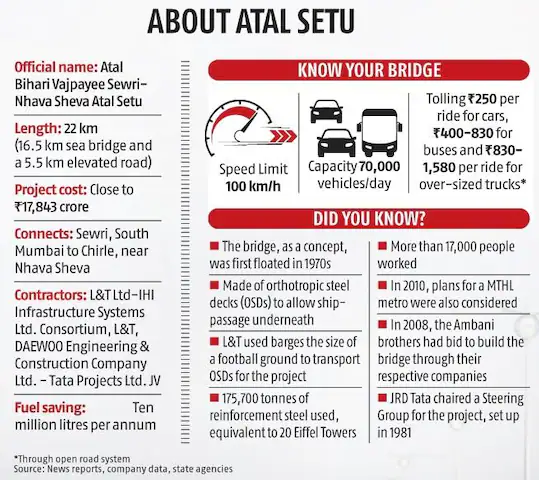
INDIA: INFRA-STRUCTURE : INDIA’s LONGEST: Atal Setu: Mumbai gets India’s Longest Sea Bridge, operations begin today

PM inaugurates the Mumbai Trans Harbour Link project.

The Mumbai Trans Harbour Link (MTHL), perhaps the most anticipated infrastructure project in the city, is set to open for regular traffic this Saturday, after Prime Minister Narendra Modi inaugurated India’s longest sea bridge on Friday. 

Named the Atal Bihari Vajpayee Sewri-Nhava Sheva Atal Setu, the 21.8 km-long, six-lane engineering marvel, of which 16.5 km is in the sea, has been built at a cost of Rs 17,840 crore, and will cut the distance between the Mumbai island city and its satellite city Navi Mumbai shorter. 

“The inauguration of Atal Setu exemplifies India’s infrastructural prowess and underscores the country’s trajectory toward a ‘Viksit Bharat’,” Modi after inaugurating the bridge. He arrived at the programme in Navi Mumbai in the evening, after his convoy drove across the sea bridge – the foundation stone of which the PM had laid around seven years ago.  

The prime minister also laid foundation stones for other development projects in the state worth more than Rs 12,700 crore. “…a budget of Rs 44 trillion for infrastructure has been presented in the 10 years of the present government. In Maharashtra alone, the central government has either completed infrastructure projects worth about Rs 8 trillion or work on them is in progress,” he said. 

The MTHL project is one of the four main infrastructure projects in the city that are likely to become operational this year — an election year for both country and Maharashtra.  

The other three, along with MTHL, are estimated to cost upwards of Rs 84,000 crore.

The MTHL project — 80 per cent of which has been funded through a debt from Japan International Cooperation Agency, where the MMRDA is the borrower – is expected to spur further economic development in Mumbai and Navi Mumbai. The MMRDA, or Mumbai Metropolitan Region Development Authority, is the nodal agency for the project.

Sanjay Mukherjee, the Metropolitan Commissioner of MMRDA, anticipates “a consistent uprising in business opportunities and economic growth in the surrounding regions” as one of the many positive outcomes of the project.

“The Atal Setu will be a huge contributor to the steady escalation of the MMR’s humongous share in our nation’s GDP in the forthcoming years,” he said.

Sanjay Sethi, chairperson for Jawaharlal Nehru Port Agency (JNPA), located in Navi Mumbai, said: “The increased connectivity, especially in the JNPA vicinity, will open up new trade opportunities, attracting investments in warehousing and logistics infrastructure, further boosting JNPA SEZ’s economy.”

The MTHL project — first conceived in the 1970s and finally awarded in 2017 – was to be completed in the early part of 2022. However, its execution saw delays, partly because of pandemic-related supply chain woes.


source/content: business-standard.com (headline edited)

NATIONAL: EQUINES: Bhimthadi Horses get stamp of Independent Breed

The pride of the cavalry of the Maratha Army in the 17th and 18th centuries, Bhimthadi horses to get the status of an independent breed.

Ranjeet Pawar, founder, All India Bhimthadi Horse Association, in a joint announcement with Sharad Mehta, head, regional station, National Research Centre of Equines, Bikaner, Rajasthan at Deccan Gymkhana on Tuesday, said that authorities will soon issue a gazette notification officially recognising the indigenous breed.

According to Pawar, Bhimthadi breed of horses originated on the banks of Bhima River in Maharashtra and “thadi” means a riverbank. The breed is found on the plateau of Deccan, including some parts of Pune, Satara, Solapur, Ahmednagar, Sangli and Kolhapur districts.

The breed was part of the cavalry of the Maratha Army in its fight against the Mughals

“As this indigenous breed was not officially recognised in India, with the support of the Agricultural Development Trust (ADT) at Baramati, a team was formed in association with the National Research Centre for Equines, Bikaner to fulfil the administrative and scientific requirements for its inclusion in the national list. A delegation of scientists led by Dr Sharad Mehta visited Baramati and surrounding areas where they interacted with farmers and horse keepers to understand the hardiness and utility of the breed,” Pawar said.

According to Mehta, blood samples of over 1,000 Bhimthadi horses were tested at the National Research Centre on Equines, Bikaner while DNA testing of over 500 samples was done to ensure that the animal does not share its DNA with any of the established breeds in India.

“The process took about three years. Of the 66 applications received for getting the recognition, eight have been approved by the committee and Bhimthadi horse is one of them. The gazette notification is expected in a month’s time,” Mehta said.

“As per the government records, the current population of Bhimthadi horses in India is 5,134,” he said.

Pawar plans to introduce Bhimthadi horses in sports like endurance and polo after getting the official stamp. Breed shows and educational workshops would also be conducted through the state to retain the breed characteristics and to improve the breeding practices of the animal.

source/content: hindustantimes.com (headline edited)

Ayodhya to get world’s largest ‘solar powered street lights line’ , set Guinness record

Uttar Pradesh Chief Minister Yogi Adityanath’s vision to transform Ayodhya into a solar city is about to get a boost through establishment of the world’s largest ‘solar powered street lights line’, with the installation of 470 solar street lights over an area of 10.2 km city between Guptar Ghat and Nirmali Kund.

The unique feat will also see Ayodhya find entry into the the Guinness Book of World Records once again, with the earlier one taking place during Deepotsav with the lighting of the highest number of earthen lamps.

Under the guidance of CM Adityanath, the Uttar Pradesh New and Renewable Energy Development Agency (UPNEDA) has already completed approximately 70 per cent of the installation work, while the remaining 160 solar street lights will be installed before January 22.

Ayodhya UPNEDA project officer Praveen Nath Pandey said here on Tuesday that by January 22, a world record will be set in the temple city with the installation of 470 solar street lights in a 10.2 km stretch from Lakshman Ghat to Guptar Ghat, extending up to Nirmali Kund.

He added that under the project, 310 solar lights have been installed from Lakshman Ghat to Guptar Ghat, while work is ongoing to install 160 solar-powered street lights in the stretch between Guptar Ghat and Nirmali Kund, covering a distance of 1.85 km. All these solar-powered street lights are LED-based, operating at 4.4 watts, and equipped with smart technology. Through their installation, the 10.2 km stretch from Lakshman Ghat to Nirmali Kund will be illuminated with a radiant glow.

The world record that the state government aims to break through a solar energy-powered project is currently registered in the name of Malham of Saudi Arabia, where 468 solar-powered lights were installed over a stretch of 9.7 km in 2021. Now, the Yogi government is gearing up to surpass this record in Ayodhya by installing 470 solar-powered lights in an area spanning 10.2 km.

Earlier, Ayodhya got listed in the Guinness Book of World Records during Diwali in 2023, when 25,000 volunteers from Avadh University lit 22.23 lakh lamps together at the ghats of river Sarayu.

Discussions are underway between the local administration, officials of UPNEDA, and representatives of the Guinness Book of World Records in this context.

source/content: thestatesman.com (headline edited)

NATIONAL: HORTICULTURE: ROSES : 40th All India Rose Convention and Rose Show at KIIT, Odisha

The 40th All India Rose Convention and Rose Show got off to a colourful start at the KIIT campus with the unveiling of four new varieties of rose on Friday.

The four new rose varieties, Lord Jagannath, Lord Lingaraj, Sephali and Radha, were unveiled by KIIT & KISS founder Dr Achyuta Samanta.

Dr Samanta highlighted the significance of the rose, tracing its origins 3.3 million years back and acknowledging its revered position as the king of flowers.

The three-day convention is a collaborative effort of the KIIT Rose Society in association with the Odisha University of Agriculture and Technology, Orissa Horticulture Society, and Directorate of Horticulture, Department of Agriculture, Government of Odisha.

The rose exhibition is open for the public from 9 am to 6 pm on January 6 and 7.

source/content: dailypioneer.com (headline edited)

IIT Kanpur’s landmark research offers new hope in cancer, brain disorder treatment

The Indian Institute of Technology Kanpur has achieved a breakthrough in biomedical research with their study of G protein-coupled receptors and chemokine receptor D6 shedding new light on the potential treatment of cancer and brain disorders such as Alzheimer’s, Parkinson’s and schizophrenia.

he Indian Institute of Technology Kanpur has achieved a breakthrough in biomedical research with their study of G protein-coupled receptors and chemokine receptor D6 shedding new light on the potential treatment of cancer and brain disorders such as Alzheimer’s, Parkinson’s and schizophrenia.

“The path-breaking research opens the doors to a new era in targeted medicine that can deliver solutions for cancer and neurological conditions for millions across the world. These diseases, which cause immense suffering and economic burden, could see a new era of effective treatment developed based on these findings! The success of this research project is also a testament to our successful collaboration with scientists across the world,” Prof S Ganesh, Director, IIT Kanpur said here on Friday.

“This project saw the team from IIT Kanpur working with researchers from Japan, the Republic of Korea, Spain, and Switzerland. Hearty Congratulations to Prof Arun Shukla and team, who have been doing outstanding research in GPCRs (G protein-coupled receptors) biology,” he said.

GPCRs are like tiny antennas on the surface of brain cells which help them to communicate and play a key role in many brain functions. When these receptors do not work properly, there are issues with communication between the brain cells leading to diseases like Alzheimer’s and Parkinson’s. This leads to symptoms and progression seen in these diseases.

Similarly, the chemokine receptor D6 functions in the immune system and is involved in the response to inflammation. In cancer, the receptor can influence the tumour environment, affecting how the cancer cells grow and spread.

The findings of the new research from IIT Kanpur will help in a greater understanding of the working of these receptors and lead to the development of new therapeutic approaches and targeted treatments for conditions such as Alzheimer’s, which affects over 50 million people worldwide, and cancer, responsible for over 10 million deaths annually.

The researchers used a high-tech method called cryogenic-electron microscopy (cryo-EM) to create detailed three-dimensional images of the receptors. This allowed them to study the 3D images of the receptors at the molecular level in great detail, helping to identify and design new drug-like molecules to correct problems with these receptors that cause disease conditions.

The research team from the Laboratory of GPCR Biology, IIT Kanpur included Prof Arun K Shukla, Department of Biological Sciences and Bioengineering and Principal Investigator GPCR Lab; Ramanuj Banerjee, Post-Doctoral Fellow; Manish Yadav, Post-Doctoral Fellow; Ashutosh Ranjan, Post-doctoral fellow, currently Faculty at Lucknow University; Jagannath Maharana, PhD scholar now heading to the Max Planck Institute of Molecular Physiology as a post-doctoral fellow; Madhu Chaturvedi, PhD scholar now heading to UCSF as a post-doctoral fellow; Parishmita Sarma, PhD student; Vinay Singh, Project JRF, now headed to IMPRS on Cellular Biophysics, Frankfurt as a PhD student; Sayanatan Saha, Project Research Fellow; and, Gargi Mahajan, Project Research Fellow.

source/content: thestatesman.com (headline edited)

INTERNATIONAL: FOOD & CUISINE: Three Indian Restaurants among the World’s Top 10 Legendary ones. They are…

hree Indian restaurants have made it to the list of top 10 legendary eateries in the world.

Taste Atlas, an experiential travel online guide, unveiled the list of restaurants that are “not just places to grab a meal, but destinations in their own right, comparable to the world’s most famous museums, galleries and monuments.”

Paragon in Kozhikode, Kerala, immensely popular for its biryani, occupied the 5th rank on the list. Lucknow’s famous Tunday Kababi, known for mouth-melting galouti kebabs, grabbed 6th spot.

“Paragon in Kozhikode, Kerala, is an emblem of the region’s rich gastronomic history, celebrated for its mastery of traditional Malabar cuisine,” Taste Atlas noted.

The travel guide called Tunday Kababi “a jewel in the crown of Lucknow’s culinary scene in India” that has “gained widespread acclaim for its Mughlai cuisine”. The star offering, the galouti kebab, is a culinary masterpiece featuring finely minced meat tenderised with raw papaya and an assortment of spices.

Another proud entry in the top legendary restaurants is Peter Cat, Kolkata, occupying the 10th spot. Found in 1975, the iconic eatery is best known for chelow kebabs.

Apart from these three Indian entries in the top 10, several other restaurants made it to the elaborate list of 100 legendary restaurants in the world. Murthal’s Amrik Sukhdev Dhaba grabbed the 16th spot while Mavalli Tiffin Rooms, Bengaluru, occupied 32nd rank. Also on the list is Karim’s, Delhi, occupying the 84th spot.

See the full list here:

How many of these Indian restaurants have you visited so far?

Watch Live TV in English

Watch Live TV in Hindi

source/content: indiatoday.in (headline edited)