Category Archives: Education

GLOBAL: ARTS & CULTURE : MUSIC & SINGING RECORD : Indian student Suchetha Satish in Dubai sets Guinness World Record for Singing in 140 Languages at concert

Suchetha Satish performed for 9 hours straight, all from memory, as prelude to COP28.

An Indian expat in Dubai has set a new Guinness World Record for the most languages sung in a concert by singing in 140 languages – for nine hours at a stretch, all from memory.

Suchetha Satish had performed her ‘Concert for Climate’ on November 24, 2023 at the Indian Consulate Auditorium in Dubai as a prelude to COP28 UN climate conference, which concluded in December in Dubai.

The Guinness World Records officially announced the success of her attempt on their website on January 3. She was presented the Records certificate by the Consul General of India in Dubai, Satish Kumar Sivan, who congratulated her. Though Satish could have sung in 150 languages, she preferred to sing in 140 as a tribute to the 140 heads of states invited to COP28.

Message of preservation

She told Gulf News: “I’m delighted and humbled by the fact that the Record has been reported and applauded by media across India and rest of the world. And more importantly the Concert for Climate and the message for climate preservation has spread far and wide, which really justifies the whole effort. We have to do everything possible to make this world a better place to live in.”

She tries to emulate her role model Shreya Ghoshal in rendering the songs “perfectly”.

Award-winning music composer M Jayachandran, who was present at Satish’s concert, said: “It was so heartening to see her smile as she was journeying through these songs. I felt so proud to be there. Suchetha is indeed an extra-ordinary artist. She sang the songs with total dedication, understanding the inner meanings of each word she was singing and at the same time not compromising on the musicality or nativity of each song.”

The first-year digital media student at Middlesex University Dubai – who also learns carnatic, hindustani and western vocals from teachers Asha Menon, Jerry Amaldev and Hanna Nielazina – aims to become an accomplished international performer and playback singer.

source/content: gulfnews.com (headline edited)
GLOBAL: WORLD’S BRIGHTEST: 9-year-old Indian-American girl Preesha Chakraborty on ‘World’s Brightest’ Students List by Johns Hopkins Centre

At the age of 6, Preesha secured a lifetime membership in the esteemed Mensa Foundation, the world’s oldest high-IQ society.

Nine-year-old Indian-American student Preesha Chakraborty has been named in the “world’s brightest” students list by the Johns Hopkins Centre for Talented Youth, based on the results of her exceptional performance in the above-grade-level tests, which assessed over 16,000 students from 90 countries. 

Preesha is a Warm Spring Elementary school student in Fremont, California, and took the US-based Johns Hopkins Centre for Talented Youth (JH-CTY) test in Summer 2023 as a Grade 3 student.

The CTY Talent Search evaluates students through various tests, including the Scholastic Assessment Test (SAT), American College Testing (ACT), and School and College Ability Test. Preesha received recognition for her outstanding performance in these assessments. She excelled in both the verbal and quantitative sections, achieving a level on par with the 99th percentile of advanced Grade 5 performances, earning her the prestigious Grand Honors.

Notably, less than 30% of students each qualify for either High Honors or Grand Honors/SET based on their test scores. This accomplishment opens several doors for Preesha, allowing her eligibility for more than 250 JH-CTY courses. These advanced courses, spanning grades 2-12, encompass a diverse range of subjects such as mathematics, computer programming, chemistry, physics, reading, and writing.

At the age of six, the child prodigy secured a lifetime membership in the esteemed Mensa Foundation, the world’s oldest high-IQ society.

This recognition follows in the footsteps of other Indian-American students like Samedha Saxena and Natasha Perianayagam, who were featured in previous years for their exceptional performances in JH-CTY tests.

The Center for Talented Youth, a non-profit organization affiliated with Johns Hopkins University, has been identifying and rewarding gifted students since its founding in 1979.

(With inputs from agencies)

source/content: ddnews.gov.in / DD News (headline edited)

IIT Kanpur’s landmark research offers new hope in cancer, brain disorder treatment

The Indian Institute of Technology Kanpur has achieved a breakthrough in biomedical research with their study of G protein-coupled receptors and chemokine receptor D6 shedding new light on the potential treatment of cancer and brain disorders such as Alzheimer’s, Parkinson’s and schizophrenia.

he Indian Institute of Technology Kanpur has achieved a breakthrough in biomedical research with their study of G protein-coupled receptors and chemokine receptor D6 shedding new light on the potential treatment of cancer and brain disorders such as Alzheimer’s, Parkinson’s and schizophrenia.

“The path-breaking research opens the doors to a new era in targeted medicine that can deliver solutions for cancer and neurological conditions for millions across the world. These diseases, which cause immense suffering and economic burden, could see a new era of effective treatment developed based on these findings! The success of this research project is also a testament to our successful collaboration with scientists across the world,” Prof S Ganesh, Director, IIT Kanpur said here on Friday.

“This project saw the team from IIT Kanpur working with researchers from Japan, the Republic of Korea, Spain, and Switzerland. Hearty Congratulations to Prof Arun Shukla and team, who have been doing outstanding research in GPCRs (G protein-coupled receptors) biology,” he said.

GPCRs are like tiny antennas on the surface of brain cells which help them to communicate and play a key role in many brain functions. When these receptors do not work properly, there are issues with communication between the brain cells leading to diseases like Alzheimer’s and Parkinson’s. This leads to symptoms and progression seen in these diseases.

Similarly, the chemokine receptor D6 functions in the immune system and is involved in the response to inflammation. In cancer, the receptor can influence the tumour environment, affecting how the cancer cells grow and spread.

The findings of the new research from IIT Kanpur will help in a greater understanding of the working of these receptors and lead to the development of new therapeutic approaches and targeted treatments for conditions such as Alzheimer’s, which affects over 50 million people worldwide, and cancer, responsible for over 10 million deaths annually.

The researchers used a high-tech method called cryogenic-electron microscopy (cryo-EM) to create detailed three-dimensional images of the receptors. This allowed them to study the 3D images of the receptors at the molecular level in great detail, helping to identify and design new drug-like molecules to correct problems with these receptors that cause disease conditions.

The research team from the Laboratory of GPCR Biology, IIT Kanpur included Prof Arun K Shukla, Department of Biological Sciences and Bioengineering and Principal Investigator GPCR Lab; Ramanuj Banerjee, Post-Doctoral Fellow; Manish Yadav, Post-Doctoral Fellow; Ashutosh Ranjan, Post-doctoral fellow, currently Faculty at Lucknow University; Jagannath Maharana, PhD scholar now heading to the Max Planck Institute of Molecular Physiology as a post-doctoral fellow; Madhu Chaturvedi, PhD scholar now heading to UCSF as a post-doctoral fellow; Parishmita Sarma, PhD student; Vinay Singh, Project JRF, now headed to IMPRS on Cellular Biophysics, Frankfurt as a PhD student; Sayanatan Saha, Project Research Fellow; and, Gargi Mahajan, Project Research Fellow.

source/content: thestatesman.com (headline edited)

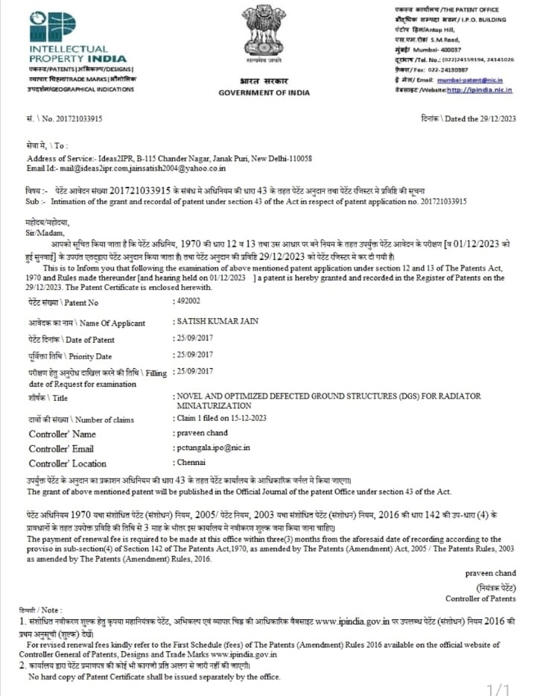
NATIONAL: PATENT: Madhya Pradesh’s Science & Innovation: SGSITS’s Professor Satish Jain Created ‘Radiator Miniaturization’ To Be Used By ISRO, DRDO

Government of India recognized and granted the patent for the invention of ‘Noble and Optimized-Effective Ground Structural for Radiator Miniaturization’ created by Shri Govindram Seksaria Institute of Technology and Science (SGSITS) professor Satish Jain. He registered a patent for the same.

“I have reduced the size of the antenna to be installed on the nano satellite,” Jain said. He added that due to this, the quality of the satellite will improve.

“This has become possible after my hard work of the last 7 years,” Jain said. The invention is expected to be useful for the sky related satellite activities of the Government of India (Indian Space Satellite Research Center ISRO, DRDO)!

“Due to the smaller size of the antenna, the possibility of expanding the service by installing more modules in the satellite increases,” Jain said.

Director of the institute Rakesh Saxena said, “Nano satellite is a small satellite platform with very high density technology, which must use reliable design.” The invention can help in reliable and efficient nano satellites, he added.

source/content: freepressjournal.in (headline edited)

INTERNATIONAL: NATIONAL: AWARDS IN CHEMISTRY: Mumbai Professor and Dean Savita Ladage Wins Prestigious Royal Society of Chemistry’s (RSC) Nyholm Prize

Professor Savita Ladage, who lives in Mumbai, has been named winner of the Royal Society of Chemistry’s Nyholm Prize for Education in recognition of contributions to chemistry education.

Based at Homi Bhabha Centre for Science Education, Tata Institute of Fundamental Research, Professor Ladage won the prize for enthusiastically advocating the importance of chemical education, through mentoring chemistry educators and initiating teacher and student programs that promote chemistry education in India.

All the winners join a prestigious list of past winners in the RSC’s prize portfolio, 60 of whom have gone on to win Nobel Prizes for their work, including 2022 Nobel Laureate Carolyn Bertozzi and 2019 Nobel laureate John B Goodenough.

Professor Ladage also receives £5000, a medal and a certificate.

After receiving the prize, Professor Ladage said: “I feel deeply honoured to receive this prize and recognition in the community of individuals who are doing work in the area of chemistry education. I am thankful to the RSC for the same. The award and recognition has motivated me further to continue my work with greater zeal and enthusiasm. I am passionate about chemistry education in general.”

Ladage is passionate about teaching and learning chemistry. She interacts with chemistry students and teachers, especially at undergraduate level. One of her main interests has been chemistry lab education and helping students to make observations more carefully and critically. She designs experiments and highlights the associated procedures, difficulties and errors involved, and the data. Savita wants to change the perception of students and teachers of chemistry lab education.

When she’s not teaching, Ladage loves writing articles about different topics in chemistry, particularly the periodic table and the challenges involved in teaching and learning chemistry.

Dr Helen Pain, Chief Executive of the Royal Society of Chemistry, said: “The chemical sciences are at the forefront of tackling a range of challenges facing our world. From fundamental chemistry to cutting-edge innovations, the work that chemical scientists do has an important role to play in building our future.

“The inspiration, innovation and dedication of those who work in education is fundamental to the progress of the chemical sciences – shaping the future and setting our young people up to tackle the challenges and the opportunities facing our society and our planet.

“Professor Ladage’s work demonstrates an outstanding commitment to chemistry education, and it is our honour to celebrate their considerable contribution.”

The Excellence in Education Prizes celebrate inspirational, innovative, and dedicated people working in primary, secondary, further education and higher education – including teachers, technicians and more. These prizes recognise a wide range of skills – from curriculum design to effective teaching, and from personal development to working culture. This category includes specific prizes for teams and for those in the early stages of their career.

source/content: timesofindia.indiatimes.com (headline edited)

INTERNATIONAL: SCIENE & TECHNOLOGY / RESEARCH: Indian-origin Professor Brajesh Singh of Western Sydney University ,Australia Honoured with the top Microbiology ‘2023 Dorothy Jones’ Award

An Indian-origin professor from Australia has been awarded the 2023 Dorothy Jones Prize for using microbiology to make a significant contribution to understanding of terrestrial life and preservation of global ecosystem.

Brajesh Singh, a global expert in the field of microbial functional ecology from the Hawkesbury Institute for the Environment in Western Sydney University, was presented the award at the British Medical Association (BMA) House in London last month.

Singh’s fundamental research provides solutions to global challenges, including environmental degradation and food insecurity.

This has been done by identifying the quantitative relationships between soil diversity and ecosystem functions and exploring how these are impacted by natural and anthropogenic pressures.

Findings from his research, identifying the causal link between soil microbial and faunal soil biodiversity and key ecosystem functions and services, have advanced crucial areas of ecosystem science, according to a Western Sydney University release.

The research findings have also informed multiple policy decisions at regional, national, and global levels, including providing key recommendations for bilateral engagements in agribusiness and trade between Australia and both India and the European Union.

He has developed innovations to boost the efficacy of existing microbial products and provided new tools for manipulating soil and plant microbiomes for an array of industries across Australia and the world, the release said.

Singh is currently working with multiple government and intergovernmental bodies, including the UN’s Food and Agriculture Organisation (FAO), to train farmers, consultants, and policy advisors in sustainable agriculture, and in the Sustainable Development Goals.

In addition, he works with the UN FAO’s Global Soil Partnership to boost the resilience of farming systems and ensure environmentally sustainable food security measures globally.

Having spent ten years honing his knowledge in Scotland before relocating to Australia, Singh also advises the European Commission on enhancing productivity in the bioeconomy.

He is a Fellow of the Australian Academy of Science; the Soil Science Society of Australia; the Soil Science Society of America, the American Academy of Microbiology, and a Humboldt Research Awardee.

Named after Dr Dorothy Jones — who served as President of Applied Microbiology International from 1989 to 1991 — the prize is part of the Applied Microbiology International Horizon Awards, which celebrate the brightest minds in the field promoting individuals and research shaping the future of applied microbiology.

source/content: daijiworld.com (headline edited)

INTERNATIONAL: GREEN INITIATIVES: IIT Mandi Wins ‘Green University’ Award at COP28 UAE

IIT Mandi’s overall goal is to reduce greenhouse gas emissions and achieve zero carbon emissions within the next 10 years.

The Indian Institute of Technology Mandi (IIT Mandi) has been honored with the Prestigious Green University Award in COP 28 UAE. This award was conferred by Green Mentors, a non-governmental organization holding special consultative status with the United Nations Economic and Social Council (ECOSOC) in the United States.

At the global level, this recognition was attributed at the prestigious CoP 28 platform.

IIT Mandi claims its vision is to raise awareness among young students and campus residents about environmental issues, as well as the conservation of nature and natural resources in the surrounding area. To maintain ecological balance, IIT Mandi is actively engaged in conducting Environment Audits, implementing Green Audits, promoting vegetarian food options on campus, the institute said.

IIT Mandi’s overall goal is to reduce greenhouse gas emissions and achieve zero carbon emissions within the next 10 years. Also, the institution aims to create a model framework for an eco-conscious campus and explore revenue generation through carbon trading.

“This achievement is the result of the unwavering efforts, commitment, and groundwork carried out by the faculty, staff, and student community through various activities,” said Prof. Laxmidhar Behera, Director, IIT Mandi.

source/content: indianexpress.com (headline edited)

INTERNATIONAL RECORDS: EDUCATION: India sends Record Number Students to U.S., Surpasses China: Report

Number of international students from India has increased by 35%, with an all-time high of 268,923 students.

India surpassed China to become the largest source of international graduate students in the United States for the first time since 2009-10, according to the Open Doors Report (ODR), published by the Institute of International Education (IIE) in partnership with the U.S. government’s Bureau of Educational and Cultural Affairs.

According to the report, released on Monday, a record number of Indian students travelled to the United States to pursue higher education for the third year in a row.

The report said the number of international students from India to the United States increased by 35%, numbering an all-time high of 268,923 students in the academic year 2022-23. “Indian students constitute more than 25% of the over one million foreign students studying in the United States,” said the US Embassy in India in a press release. The number of Indian graduate students rose by 63% to 165,936 students, an increase of nearly 64,000 students, compared to last year, while Indian undergraduate students also increased by 16%, the Embassy added.

As many as 69,062 students opted for optional practical training (OPT), a type of temporary work permission that allows eligible students to get real-world experience related to their field of study. “The U.S. Embassy and Consulates in India issued record high numbers of student visas during the main student visa season of June-August 2023. Consular officers across India issued 95,269 visas in the F, M, and J categories. This is an 18% increase over 2022 during the same timeframe,” the release added.

U.S. Ambassador to India, Eric Garcetti said that Indian students are bringing both countries closer together. “We celebrate the strength of the Indian educational system that prepares students to compete globally and look forward to seeing India continue to lead. We also look forward to balancing these record numbers. We want to see equal numbers of women pursuing studies in the United States and see more U.S. students coming to experience all that India has to offer,” he said.

source/content: thehindu.com (headline edited)

IIT-Bombay researchers patent technology that will save crores for steel industry and reduce emissions

A groundbreaking energy-efficient carbon dioxide (CO2) capture technology has been developed, offering the potential to revolutionize the steel industry while advancing India’s aim of achieving net-zero emissions by 2070. Developed by the National Centre of Excellence in Carbon Capture and Utilisation (NCoE-CCU) at IIT Bombay with support from the Department of Science and Technology (DST), this innovation enables the conversion of CO2 into carbon monoxide (CO) under electrocatalytic conditions at ambient temperatures, even in the presence of water.

Dr Arnab Dutta and Dr Vikram Vishal, along with dedicated researchers at the NCoE-CCU, have successfully patented the CO2-to-CO conversion technology. Moreover, their work is set to be published in the prestigious international journal, Nature Communications.

Carbon monoxide (CO) is widely used in the industrial sector, particularly in the form of synthesis gas (syngas). In the steel industry, CO is indispensable for converting iron ores into metallic iron within blast furnaces. However, the traditional method of CO generation involves the partial oxidation of coke or coal, leading to substantial CO2 emissions as a byproduct. 

The innovation developed by IIT Bombay’s NCoE-CCU offers a more sustainable approach by converting emitted CO2 into valuable CO. What sets this technology apart is its ability to function at ambient temperatures (25-40 °C) with minimal energy requirements.

This electrocatalytic reaction can efficiently harness energy from renewable sources, such as solar panels or windmills, ensuring a carbon-neutral process for converting CO2 to CO. Notably, this advancement aligns with India’s environmental goals and represents a critical pathway for mitigating greenhouse gas emissions.

The technology has immense potential for various industrial applications and is currently in the process of scaling up, thanks to the recent incubation of UrjanovaC Private Limited. The steel sector, in particular, stands to benefit from this breakthrough. Additionally, another technology for aqueous-based CO2 capture and conversion to calcium carbonate, originating from DST-supported NCoE-CCU activities, has been licensed to UrjanovaC Private Limited, incubated through SINE at IIT Bombay.

source/content: newsable.asianetnews.com

NATIONAL: SPACE INFORMATION / I.T. : Union Minister launches Web Portal ‘Apna Chandrayaan’ on ‘Mission Chandrayaan-3’ for School Children

Developed by NCERT under the aegis of the Department of School Education and Literacy (DoSEL), the Ministry of Education, Dharmendra Pradhan also released 10 special modules on Chandrayaan-3.

Union Education Minister Dharmendra Pradhan on Tuesday launched a web portal ‘Apna Chandrayaan’ having activity-based support material, including colouring books, online quizzes, and jigsaw puzzles for school students on Mission Chandrayaan-3.

Developed by NCERT under the aegis of the Department of School Education and Literacy (DoSEL), the Ministry of Education, Pradhan also released 10 special modules on Chandrayaan-3.

This offers a comprehensive overview of its various facets, including scientific, technological, and social aspects, as well as the emotional journey and team spirit of the scientists involved.

On the lines of the Mission Chandrayaan-3 module, the ministry plans to come up with more such modules on 14 different topics, including women empowerment, COVID-19 vaccination, India’s G20 Presidency, etc.

“Success of Chandrayaan 3 is one of the most significant achievements of the 21st century that has inspired the children of the country the most,” he said.

He suggested the development of the app of the web portal to make it more accessible in facilitating self-learning among students.

“Chandrayaan 3 has ignited confidence among students and inspired them to understand technology, which will help in developing scientific temperament among them,” Pradhan said.

He also said that Prime Minister Narendra Modi has requested Dr. Sreedhara Panicker Somanath, Chairman, of ISRO, and Secretary of the Department of Space, to take Chandrayaan 3 stories to the children of the country.

He also urged him to make science fun for the students.

“India will be the Viswa Guru sharing knowledge for the global good,” he said.

He suggested to the National Council of Educational Research and Training (NCERT) to bring out social stories that will make education accessible, affordable, and qualitative, and help in bringing gender parity.

At the occasion, Dr Somanath said India completed the Chandrayaan 3 Mission by using indigenous technologies and requested students to watch the launch of Gaganyaan on October 21.

source/content: newindianexpress.com (headline edited)