Category Archives: Uncategorized

ICHR events to commemorate India’s young freedom fighters

The ICHR will honor 160 young freedom fighters from 1857-1947 with events from May 2026 to inspire youth through their stories.

The Indian Council of Historical Research (ICHR) will organise a programme to honour 160 young freedom fighters who died from 1857 to 1947, officials said on Sunday.

Under its the theme “martyrs under 20 years”, the ICHR will oraginse exhibitions, seminars and youth conclaves from May 2026 to “inspire youth through stories of unsung heroes”. Coinciding with the birth centenary of Baji Rout, India’s youngest freedom fighter and martyr who was shot dead by British police at the age of 12 in Odisha’s Dhenkanal, the first leg of the programme is slated to be held in Odisha. Rout’s ongoing birth centenary celebrations, which began last October, will conclude on October 5 this year.

“The activities, costing over ₹75 lakh, will feature stories of teenage victims of the Jallianwala Bagh massacre to young revolutionaries like Khudiram Bose (19), and Kanaklata Barua (16), to child martyrs like Kali Bai (12) with an emphasis on reclaiming ignored histories,” officials said.

ICHR, an autonomous body under the ministry of education, in its latest research projects committee held in the last week of February 2026, has approved the proposal to organise academic activities on the theme martyrs under 20 years in collaboration with Indian Council of Social Science Research (ICSSR). The objective of the project is “to spread awareness among youth and students about the sacrifice and patriotism of freedom fighters” and “to instill love for the motherland and a sense of national responsibility among the younger generation,” according to minutes of the meeting, approved in the third week of March 2026. HT has seen the minutes of the meeting.

The activities will include student and youth congregations, seminars and conventions across universities, colleges and schools; curated exhibitions on the theme; publications and monographs; talks and interactive sessions; essay competitions, debates and discussions; as well as the production and screening of documentary films.

Officials said the programme will highlight figures such as 12-year-old Kali Bai, who was shot in 1947 while trying to save her teacher; 16-year-old Kanaklata Barua, killed while leading a procession during Quit India; and 19-year-old revolutionary Khudiram Bose, executed in 1908. The list also includes several child victims of Jallianwala Bagh such as nine-year-old Hassan Mohammad and 12-year-old Hukam Singh, alongside teenage revolutionaries like Kartar Singh Sarabha, one of the youngest members of the Ghadar Party, who was executed in 1915 for his role in anti-colonial activities against British rule.

Historian Narayani Gupta said the approach of isolating teenage martyrs may miss a broader historical context, suggesting it would be more meaningful if it conveyed the diversity of places and moments in which these events occurred. “The theme could be an opportunity to convey a stronger sense of geography and the varied moments when history took unexpected turns… otherwise, there is a possibility it may remain broadly celebratory and shaped by present-day concerns,” Gupta said.

ICHR member secretary (officiating) Om Jee Upadhyay said the list of 160 Indian martyrs below the age of 20 has been drawn from primary archival sources and original documents. “The programmes on the theme of martyrs under 20 years old will be held nationwide. Through these programmes, ICHR aims to inspire youth, inculcate a sense of patriotism, and bring attention to lesser-known freedom fighters,” he said.

Among other proposals, the ICHR approved a two-day national seminar on Guru Tegh Bahadur to mark his 350th Shaheedi Diwas, as well as a two-day national seminar on the contribution of South Odisha to India’s traditional knowledge systems.

source/content: hindustantimes.com (headline edited)
Indian Army gets its first batch of Adani Defence’s Prahar light machine guns

A company spokesperson says total order for the LMGs stands at around 40,000. The first lot has 2,000 weapons.

Adani Defence and Aerospace on Saturday delivered the first batch of 2,000 Prahar light machine guns (LMGs), manufactured under the Make in India initiative, to the army.

The company manufactures the 7.62 mm-calibre weapon at its Small Arms Complex located on the outskirts of Gwalior.

A ceremony was held on the factory premises on Saturday to hand over the LMGs to the army. A. Anbarasu, DG Acquisition, ministry of defence; Adani Defence and Aerospace CEO Ashish Rajvanshi and other senior officials of the private firm were present.

Anbarasu later flagged off a series of trucks carrying the first batch of the LMGs meant for the army.”

The journey that has begun today took us six years, starting from bid submission, and we have delivered it 11 months ahead of schedule,” Rajvanshi said.

“The original timeline, which was given to us by the customer, was over seven years, but I can assure you that in the next three years the full order will be delivered.”

A company spokesperson said the total order for the LMGs stands at around 40,000.

Anbarasu praised the firm for saving several months by delivering ahead of schedule and said it shows there is the ability to “race and fire” against time in turning contracts into deliveries.

The government stands shoulder-to-shoulder with defence industry partners, he said.

source/content: telegraphindia.com (headline edited)

European fintech firm Revolut plans 40% global workforce in India by 2026

The new positions will span product development, support functions and financial services functions such as payment processing and fraud investigations.

European fintech firm Revolut plans to have around 40% of its global workforce based in India by the end of 2026 as it expands its India global capability centre.

The company, which in 2025 committed 500 million pounds ($669.8 million) to its India business and GCC over five years, said it will fill 1,600 roles in its India centre through 2026, taking its headcount in the country to 5,500 by year-end.

The new positions will span product development, support functions and financial services functions such as payment processing and fraud investigations.

Revolut currently employs 12,000 people globally.

Global capability centers in India, once seen as low-cost outsourcing hubs, now handle operations, finance, research and development for their parent corporations.

Jonathan Beaney, Revolut’s head of talent acquisition, called India one of the “deepest and most dynamic talent pools in the world”.

“Our India tech hub is central to our global scale… the technical caliber, ambition and excellence we see here make India a natural long-term home for Revolut,” Beaney said.

The GCC expansion is, however, separate from Revolut’s India business.

India CEO Paroma Chatterjee told Reuters that about a third of Revolut’s processes are now run from India, includingwork on routine transaction monitoring and AI-based alerts.

“Things made visible using the India tech stack, like video KYC – more intelligence came in from the India GCC to share that knowledge overseas to try to implement it in other markets to have tighter onboarding,” Chatterjee said.

Revolut, founded in 2015, is one of Europe’s leading fintech companies with a $75 billion valuation.

In India, the company is authorised to issue prepaid payment instruments and aims to launch its product next quarter, the company said in a statement.

source/content: telegraphindia.com (headline edited)
.

Biodiversity boost: Study documents 11 new species of dragonflies, damselflies in Sikkim Himalayas

The findings increase the total number of known odonate species in Sikkim from 82 to 93.

A scientific study conducted by the Sikkim University recorded 11 new species of dragonflies and damselflies for the first time in the Himalayas in the state.

The research, published recently in the journal ‘Proceedings of the National Academy of Sciences, India Section B: Biological Sciences’, was conducted by Neera Rawat, a PhD scholar in the Department of Zoology of the university, under the supervision of Professor Bhoj K Acharya of the department, along with joint supervision by K A Subramanian of the Zoological Survey of India, an official statement said.

“These new discoveries highlight the rich yet understudied taxa of the region and significantly adds to our understanding of insect biodiversity in the region,” it said.

Dragonflies and damselflies, collectively known as odonates, are considered key indicators of environmental health. Their life cycle spans both water and land, with larvae developing in freshwater habitats such as streams and ponds, and adults occupying surrounding vegetation, the statement said.

Because of this amphibiotic life cycle, the occurrence and higher diversity of odonates often reflect the ecological condition and better quality of freshwater ecosystems.

In addition to their ecological importance, odonates serve as natural biocontrol agents as both larvae and adults. This makes them an important component of ecosystem functioning and biodiversity, it said.

Fieldwork for the study was conducted between April and October 2024 across multiple locations in Sikkim, including areas around Gangtok, Jorethang and Mangan, representing different environmental and urbanisation gradients.

Researchers surveyed streams, rivulets and other freshwater bodies, recording a total of 52 species, including 28 dragonflies and 24 damselflies, it said.

Of these, 11 species were documented in the state for the first time. These include Aristocyphatrifasciata, Calicnemiaimitans, Coelicciaschmidti, Gynacanthasubinterrupta, Lamelligomphusrisi, Nepogomphusmodestus, Perissogomphusstevensi, Scalmogomphusbistrigatus, Stylogomphusinglisi, Cratillalineata and Sympetrum orientale, the statement said.

The findings increase the total number of known odonate species in Sikkim from 82 to 93, extending the known range of these insects into the eastern Himalayan region, it said.

Researchers have called for continued studies to better understand the distribution, population trends and ecological roles of odonates, as well as to support conservation efforts in fragile mountain ecosystems.

Except for the headline, this story has not been edited by The Telegraph Online staff and has been published from a syndicated feed.

source/content: telegraphindia.com (headline edited)

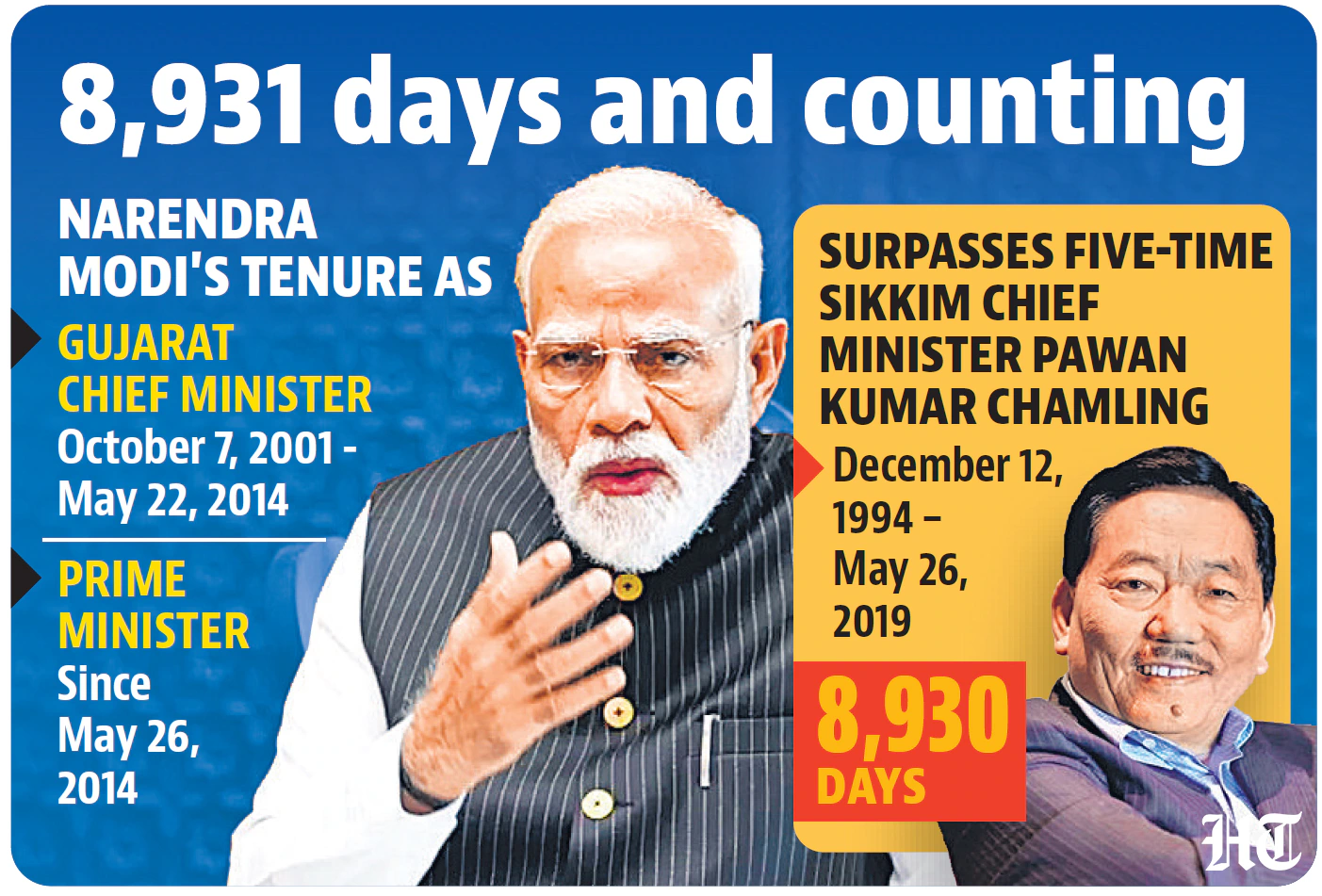
8,931 days and counting: PM Narendra Modi is India’s longest-serving head of government

The milestone underscores PM Narendra Modi’s long and continuous tenure in executive office, which now extends close to 25 years.

Prime Minister Narendra Modi on Sunday became the longest-serving head of a government in India, surpassing former Sikkim chief minister Pawan Kumar Chamling in total days in office, a milestone that drew praise from senior members of his cabinet and top leaders from the ruling Bharatiya Janata Party (BJP).

With 8,931 days as head of government — spanning his tenure as Gujarat chief minister and as Prime Minister — Modi edged past Chamling’s record of 8,930 days, marking a significant moment in India’s political history.

Union home minister Amit Shah described the development as “a milestone rooted in service, hard work and unwavering commitment”. In a post on X, Shah said: “PM Modi Ji’s 8,931 days in public life, first as Gujarat CM and now as Prime Minister reflect a deep dedication to nation-first governance, integrity in action, and tireless service to every citizen.”

Defence minister Rajnath Singh also congratulated the PM, saying, “Pure devotion to the nation and its people defines PM Modi Ji.” “With 8,931 days in public office as head of government, this moment reflects his deep commitment to nation-first governance, integrity in action, and tireless service to every citizen,” he said on X.

Narendra Modi has held the Prime Minister’s Office since 2014. (HT Photo)

Commerce and industry minister Piyush Goyal termed the milestone a “matter of pride”, noting that Modi’s journey in public life “reflects an unwavering commitment to inclusive development”. In his X post, Goyal said: “…His journey of Jan Seva reflects an unwavering commitment to inclusive development. Rooted in hard work and firm resolve towards nation-building, his years in public service continue to strengthen India’s growth story.”

BJP chief Nitin Nabin hailed the milestone, saying in a post on X in Hindi: “Under his leadership, India’s global stature has risen, and “Viksit Bharat” has been established as a national campaign rooted in public participation. Inspired by the spirit of “Nation First,” this tenure sets numerous high standards, serving as an inspiration for us all.”

The milestone underscores Modi’s long and continuous tenure in executive office, which now extends close to 25 years. Before moving to the national stage, he served as Gujarat’s chief minister for over a decade, becoming one of the state’s longest-serving leaders. He is also the PM with the longest prior experience as a chief minister and the first to have been born after Independence.

Modi has led the BJP to three consecutive victories in the Lok Sabha elections — in 2014, 2019 and 2024 — consolidating his position as one of India’s most enduring political leaders.

Reflecting on his journey last year, when he entered the 25th year as head of government, Modi recalled taking oath as Gujarat chief minister in 2001 under “very testing circumstances”, including a devastating earthquake, droughts and political instability.

“It has been my constant endeavour to improve the lives of people and contribute to national development,” Modi had said, adding that those early challenges strengthened his resolve to rebuild Gujarat. He described the state’s transformation during his tenure as the emergence of a “powerhouse of good governance”, citing progress in agriculture, industry and infrastructure.

He also pointed to the political context ahead of the 2014 general elections, when he was named the BJP’s prime ministerial candidate in 2013, a period he described as one marked by a “crisis of trust and governance”. Modi credited voters for giving his party a decisive mandate.

source/content: hindustantimes.com (headline edited)

‘ ₹40 lakh loan, dad mortgaged land’: Indian techie’s journey to Microsoft leadership role inspires internet

Priyanka Vergadia shared a video on Instagram recounting her early struggles and the risks she took while moving to the US for higher education.

An Indian-origin techie’s post about her journey from taking a ₹40 lakh student loan to becoming a senior leader at Microsoft has struck a chord online. Priyanka Vergadia, now a Senior Director, Developer GTM and Marketing at Microsoft, shared a video on Instagram recounting her early struggles and the risks she took while moving to the US for higher education.

“I took a ₹40 lakh student loan and boarded the first-ever flight of my life, a one-way ticket from India to the US for my master’s. Everything was at stake. My dad had mortgaged our land for that loan. Even the ticket was taken on loan,” she shared in an Instagram post.

“There was a quiet pressure that I didn’t fully understand yet, but could feel,” she added.

Vergadia described the challenges of adapting to a new academic system and managing life independently in a new country. She said that her first semester in the US was “not easy” because of the differences in teaching styles and the struggle of adjusting to a new environment. Beyond academics, she said that she had to learn everyday skills – from cooking and cleaning to managing expenses – all while dealing with the constant pressure of repaying loans. “I have to get a job immediately after graduation because I’ve got those loans to repay,” she recalled thinking at the time.

From student loans to big tech companies

But despite the pressure, Vergadia said that hope kept her going. “A quiet excitement about the life that might be possible. Belief that the risk would pay off eventually,” she said.

Reflecting on her journey today, Vergadia said she has worked at global tech giants including Google, Microsoft and Intel, and has travelled extensively for work. She also shared a personal milestone – bringing her parents to the US for her graduation, marking their first-ever flight.

“And yet, no matter how many flights I take, that first flight has a special place in my heart,” she said.

In her caption, Vergadia reflected on how such uncertain beginnings shape resilience and confidence over time. “They teach you resilience without announcing it. They teach you independence without asking permission. And slowly, they build a confidence that doesn’t come from certainty, but from persistence,” she wrote.

She also offered a message for others at the start of similar journeys. “If you’re standing at the beginning of something uncertain right now, know that it’s okay to feel both nervous and hopeful at the same time. You got this,” she wrote.

Social media reactions

The post has been widely praised online, with many users calling her story relatable and motivating.

“The Risk was more than worth it. Congratulations.. It Opened a whole world of opportunities for you,” one user commented.

Another wrote, “A True influencer @pvergadia Kudos to you! Thanks for inspiring millions through content like this!”

Several users also shared their own migration stories, echoing similar struggles and aspirations.

source/content: hindustantimes.com (headline edited)

Bibha Chowdhuri: a barrier breaker in STEM

From being one of the first women to gain a postgraduate degree in physics to becoming the first woman researcher in TIFR’s cosmic-ray group, Bibha Chowdhuri shines bright as an icon in the field of STEM…

A young girl was born in the early 1900s in Kolkata, an era when girls were barely given an education and were often pushed into marriages at a very young age. She, however, stood out and went on to become one of the first Indian women to obtain a postgraduate degree in physics. This is the story of Bibha Chowdhuri.

A progressive childhood

Born in 1913, Bibha Chowdhuri was born into a family of progressive views — one that encouraged her to study beyond school and pursue science, in particular physics, a subject rarely touched by women of the time.

In 1936, she completed her MSc in physics from Calcutta University, believed to be the only woman in her class and among the very first few Indian women to obtain a postgraduate degree in physics. She walked through corridors and classrooms untouched by women before, fighting battles — subtle and otherwise. 

In later interviews, she often talked about how very few women were entering physics, and it’s important to encourage more participation to ensure equal decision-making powers when it comes to technology and power in modern society. 

Meeting the mentor

After her MSc, Bibha wanted to do research in cosmic rays and subatomic particles, an ambitious choice at a time when experimental particle physics itself was still emerging globally. 

She approached Debendra Mohan Bose, a renowned physicist, to work under his guidance. Initially, like many senior scientists who had reservations about taking women into serious research roles, Bose was also reluctant. However, Chowdhuri persisted, and he eventually accepted her into his group, which was forming a new cosmic-ray research program in Kolkata. 

Between roughly 1938 and 1942, she and D.M. Bose published several important papers on cosmic-ray particles, including early observations related to mesotrons, particles now known as mesons. Their work used high-altitude stations, where Bibha was responsible for setting up emulsion plates, retrieving them after exposure, and meticulously analysing them under the microscope. 

First Indian woman PhD in physics

Soon, Chowdhuri moved to the United Kingdom to deepen her research and joined the University of Manchester. Under Patrick M.S. Blackett, she continued to study cosmic rays and extensive air showers, now embedded in a major international centre of physics. Working past cultural shocks, gender, and racial prejudices in a colonial era is definitely not a cakewalk. Yet she advanced enough to earn her PhD in 1945, making her the first Indian woman to obtain a doctorate in physics. 

It was during her time in Manchester that a local newspaper profiled her as “India’s new woman scientist,” highlighting both her scientific work and her status as a rare woman physicist from a colonised country. That article gave her the kind of public acknowledgement she seldom received in India, as well as recorded her concern that too few women were entering physics. In 1949, after her PhD, Chowdhuri returned to an independent but scientifically fragile India. 

At that time, Homi J. Bhabha was building the Tata Institute of Fundamental Research (TIFR) in Mumbai into a flagship centre for theoretical and experimental physics. On Blackett’s recommendation, Bibha joined TIFR and became the first woman researcher in the institute’s cosmic-ray group.

A woman of firsts

Bibha Chowdhuri is often described as a “woman of firsts” in Indian physics: first woman to obtain a PhD in physics from India, first woman researcher at TIFR, and one of the first women anywhere to make sustained contributions to cosmic-ray and particle physics. Yet, for decades, her name remained largely invisible from the industry’s history.

In today’s age

In recent years, historians of science, journalists, and institutions have begun to recover Bibha Chowdhuri’s legacy. In 2018, almost 30 years after her demise, her biography, A Jewel Unearthed: Bibha Chowdhuri, was published by Rajinder Singh and Suprakash C. Roy. 

In an age where women in STEM are a growing topic of discussion, Bibha Chowdhuri stands as a beacon of motivation and encouragement for women to walk the STEM path without doubts and their heads held high.

source/content: thehindu.com (headline edited)

24-hour Speed Post launch follows months of testing, air capacity enhancement

What made the time-bound guarantee possible was getting guaranteed blocks of space on passenger flight cargo holds, which India Post has used for years to transmit Speed Post articles faster.

The Department of Posts’ (DoP) announcement of 24 and 48-hour guaranteed Speed Post services follows months of testing, and the resolution of a key logistical hurdle, Ministry officials told The Hindu. The facility includes letters and parcels between Mumbai, Hyderabad, Bengaluru, Delhi, Chennai and Kolkata. What made the time-bound guarantee possible was getting guaranteed blocks of space on passenger flight cargo holds, which India Post has used for years to transmit Speed Post articles faster.

Regular commercial passenger flights routinely carry goods for courier and logistics firms, and India Post has been among those that utilise the spare capacity after the cargo hold is done loading passenger luggage. However, last year, the DoP floated a tender seeking “hard blocked” space, so that excess demand wouldn’t lead to mail bags being tossed out and used in the next flight.

“We have five airlines” with hard blocked space, Dushyant Mudgal, Deputy Director General of Mail Operations at DoP, told The Hindu. “We identified particular airlines for particular slots, and we have identified how much weight we are committing to each airline.” There is “redundancy” to make sure that multiple flights for each origin-destination pair of cities, so that if a mail bag misses one flight on a day, it can still reach the same day.

The 24 Speed Post facility, which has been promised over the last year by the government, was notified last week. The government held an event announcing it on Tuesday.

With dedicated capacity secured, India Post piloted 24-hour delivery with regular Speed Post consignments, closely tracking each article for months, seeing where weak points in terms of delivery were. “There are regular as well as a different set of personnel for delivery, with one set doing delivery from 9.30 a.m. to 12.30 p.m., and the second set doing 12.30 p.m. to 8.30 p.m.,” Mr. Mudgal said.

Bookings for 24 Speed Post and 24 Speed Parcel, which are available with the same acknowledgement and insurance facility as the erstwhile Speed Post, will be accepted from certain PIN codes — to be announced later by India Post — from the six metros, with a gradual enlarging of which post offices can accept bookings. “Speed Post 48 can be accepted at any location in the six cities,” Mr. Mudgal said. “But for next day delivery, we have identified certain post offices; in Delhi, there are 44, including bulk booking centres and head post offices.” 

Inter-city Speed Post and Parcel 24 bookings can cost anywhere from ₹94-186, depending on the weight of the consignment and the distance it has to travel, plus GST. 

E-commerce

Minister for Communications Jyotiraditya Scindia expressed the hope that e-commerce firms would avail of both the 24 and 48 hour services. “Today, parcels are only 5% of our business, but it is our common objective that parcels have to become the growth engine of our enterprise,” Mr. Scindia said, noting that already, parcel growth stood at 44% year over year.

“There is no reason we cannot become the fulfillment delivery engine for every e-commerce supplier,” Mr. Scindia said. “Amazon, Shiprocket, Flipkart… name the company and we should be the delivery organisation. Speed Post parcel will also have our OTP delivery, Aadhaar verification, real time tracking, [and] specialised packaging.” 

source/content: thehindu.com (headline edited)

Top French honour forex-envoy Jawed Ashraf

France awarded the Commandeur de la Légion d’Honneur to former Indian envoy Jawed Ashraf for his contributions to strengthening bilateral relations.

France on Wednesday conferred the Commandeur de la Légion d’Honneur — one of the country’s highest civilian honours — on former Indian envoy to Paris, Jawed Ashraf, in recognition of his contributions to strengthening bilateral relations.

Ashraf, who served as envoy to France during 2020-2024, was presented the award by Ambassador Thierry Mathou during a ceremony at the French embassy on Wednesday. He joined the Indian Foreign Service in 1991 and was appointed chairman of the Indian Trade Promotion Organization after his retirement in 2024.

“Ambassador Ashraf’s remarkable career and personal dedication have been pivotal in accelerating and deepening the bilateral relations between our two nations,” Mathou said, adding that Ashraf’s tenure envoy to France saw landmark achievements.

“I am honoured to be conferred the Insignia of the Commander of the Legion of Honour by the French Republic. It is particularly special to follow seven great luminaries of modern India, who have been earlier recipients of this honour,” Ashraf said. He added that the award is a reflection of the high importance and priority that France attaches to its relations with India and a testimony to the extraordinary progress made in the India-France strategic partnership under the leadership of Prime Minister Narendra Modi and President Emmanuel Macron.

During his stint as Indian envoy to France, the two countries took several steps to deepen cooperation in strategic areas and defence, including the purchase of 36 Rafale combat jets by the Indian Air Force. Ashraf also promoted the joint development and manufacture of military hardware.

The Legion of Honour was instituted in 1802 and has several levels, including the Grand Cross, Grand Officer, Commander, Officer and Chevalier. The Commander of the Legion of Honour has been awarded to only seven Indians so far – JRD Tata, Ratan Tata, Amartya Sen, Ravi Shankar, Satyajit Ray, SH Raza and Manna Dey. Ashraf is the first Indian diplomat to receive the honour.

source/content: hindustantimes.com (headline edited)

How two school friends from Howrah built a drone component-maker start-up called DarkMatter

The team at the firm, whose client list includes the Indian military, say there are several independent drone makers in Bengal with no ecosystem to support them.

Arnava Chakraborty and Anik Bhattacharya, like many youngsters in Bengal, were part of bands in school and college. The two school friends from Methodist Dankuni always wanted to build something, be it a guitar amplifier or something more sophisticated.

That passion resulted in DarkMatter, a start-up that makes drone components in the narrow lanes of Bally Halt in West Bengal, a state not world famous for being business-friendly.

Arnava Chakraborty and Anik Bhattacharya, like many youngsters in Bengal, were part of bands in school and college. The two school friends from Methodist Dankuni always wanted to build something, be it a guitar amplifier or something more sophisticated.

That passion resulted in DarkMatter, a start-up that makes drone components in the narrow lanes of Bally Halt in West Bengal, a state not world famous for being business-friendly.

DarkMatter started in a rented room that one of Bhattacharya’s relatives let them use with a single fan to keep it cool. Now, the single room has AC and an automated machine to assemble the drone parts, and unlimited snacks for long night sessions of programming.

Bhattacharya and Chakraborty have completed their engineering in Electronics and Electricals respectively from Academy of Technology, Adishaptagram.

Arnava Chakraborty and Anik Bhattacharya, like many youngsters in Bengal, were part of bands in school and college. The two school friends from Methodist Dankuni always wanted to build something, be it a guitar amplifier or something more sophisticated.

That passion resulted in DarkMatter, a start-up that makes drone components in the narrow lanes of Bally Halt in West Bengal, a state not world famous for being business-friendly.

DarkMatter started in a rented room that one of Bhattacharya’s relatives let them use with a single fan to keep it cool. Now, the single room has AC and an automated machine to assemble the drone parts, and unlimited snacks for long night sessions of programming.

Bhattacharya and Chakraborty have completed their engineering in Electronics and Electricals respectively from Academy of Technology, Adishaptagram.

“Anik and I have known each other since childhood,” Chakraborty tells My Kolkata. “We studied in the same school. We became proper friends in college. We always wanted to make something, be it an amplifier or a drone.”

The duo co-founded DarkMatter, which makes drone components such as flight controllers and electronic speed controllers, in 2022, and licensed it a year after. Now, DarkMatter is a four-man team, with Himadri Mukherjee as production manager and Rahul Setty as manufacturing handler.

Using four operating systems to fly-test their drones, the start-up has quickly become a force in the emerging market of drone making. DarkMatter says it is the only company of its kind in Bengal and the third such company in India.

“We have had to learn everything on our own,” says Mukherjee. “From flight simulations to operating systems, I learnt from the founders, who in turn learnt from trial and error.”

The idea for DarkMatter was formed when an acquaintance brought a large drone to Bhattacharya around 2022 to figure out how to use it.

“Once we dived into the components, we saw there is almost no sustainable market for drone enthusiasts. From no reliable component supplier to product quality, everything was haywire. That is how the idea of DarkMatter came into being,” Bhattacharya says.

“In China, Japan, or Switzerland, the electronics industry is developed. They have been developing from silicone. When they build a motherboard, they know what to do with the board. When the PCB was manufactured, they did the same thing. So, they see the industry at every stage.,” Chakraborty explains.

“We are seeing all these developments suddenly, where advancements have taken leaps. So, we are trying to grow from that stage with that backlog of knowledge.”

The DarkMatter folks say there are several independent drone makers in Bengal with no ecosystem to support them.

“Many people are making drones in Bengal. But the total, if you call it the infrastructure of business or maybe the start-up ecosystem, is lagging because there is no proper support,” Bhattacharya says. “Proper support comes in the form of funds, which should be distributed to start-ups who are doing real things or solving problems.

“Given the history of Bengal, no one wants to invest here either,” he adds. “In India, there are three prominent companies. One is us. The other two are IIT-backed.”

The slow growing research and development section for drone making thus faces a problem.

“People who develop things, because they have funds, they have a mental peace that even if the first two prototypes do not work, there’s a cushion. From the third prototype maybe it will show some results,” says Chakraborty.

Because Bengal lacks that cushion of funding for research, it is essentially the added risk for companies like DarkMatter to create prototypes for newer innovations, he says.

The team at DarkMatter say they have sold bulk orders to private buyers as well as Indian military divisions.

“The layman part [of drone usage] is for delivery of goods for a distance of 5 to 10km. Then there is surveillance. Daily progress update of what is happening and not. Then there is the mining sector. [Through drones] you get the daily report of how the mining is going on. There’s agriculture, leisure photography, and racing.

“Then, there is military use – from aerial surveillance to sending arms and ammunition. Drones can be also used as kamikaze drones, which reach a specified location and destroy stuff,” said Bhattacharya.

The Indian Chamber of Commerce has featured the duo in its Success Story magazine, and the company has also won first place at an all-India innovation conference in Delhi.

source/content: telegraphindia.com/ my-kolkata (headline edited)