Category Archives: Transport

INDIA: INFRA-STRUCTURE : INDIA’s LONGEST: Atal Setu: Mumbai gets India’s Longest Sea Bridge, operations begin today

PM inaugurates the Mumbai Trans Harbour Link project.

The Mumbai Trans Harbour Link (MTHL), perhaps the most anticipated infrastructure project in the city, is set to open for regular traffic this Saturday, after Prime Minister Narendra Modi inaugurated India’s longest sea bridge on Friday. 

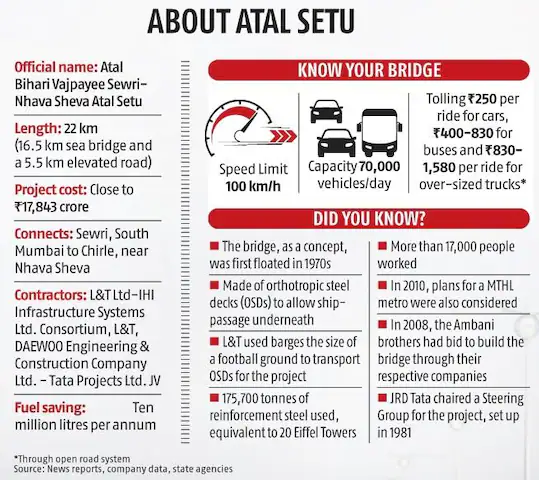
Named the Atal Bihari Vajpayee Sewri-Nhava Sheva Atal Setu, the 21.8 km-long, six-lane engineering marvel, of which 16.5 km is in the sea, has been built at a cost of Rs 17,840 crore, and will cut the distance between the Mumbai island city and its satellite city Navi Mumbai shorter. 

“The inauguration of Atal Setu exemplifies India’s infrastructural prowess and underscores the country’s trajectory toward a ‘Viksit Bharat’,” Modi after inaugurating the bridge. He arrived at the programme in Navi Mumbai in the evening, after his convoy drove across the sea bridge – the foundation stone of which the PM had laid around seven years ago.  

The prime minister also laid foundation stones for other development projects in the state worth more than Rs 12,700 crore. “…a budget of Rs 44 trillion for infrastructure has been presented in the 10 years of the present government. In Maharashtra alone, the central government has either completed infrastructure projects worth about Rs 8 trillion or work on them is in progress,” he said. 

The MTHL project is one of the four main infrastructure projects in the city that are likely to become operational this year — an election year for both country and Maharashtra.  

The other three, along with MTHL, are estimated to cost upwards of Rs 84,000 crore.

The MTHL project — 80 per cent of which has been funded through a debt from Japan International Cooperation Agency, where the MMRDA is the borrower – is expected to spur further economic development in Mumbai and Navi Mumbai. The MMRDA, or Mumbai Metropolitan Region Development Authority, is the nodal agency for the project.

Sanjay Mukherjee, the Metropolitan Commissioner of MMRDA, anticipates “a consistent uprising in business opportunities and economic growth in the surrounding regions” as one of the many positive outcomes of the project.

“The Atal Setu will be a huge contributor to the steady escalation of the MMR’s humongous share in our nation’s GDP in the forthcoming years,” he said.

Sanjay Sethi, chairperson for Jawaharlal Nehru Port Agency (JNPA), located in Navi Mumbai, said: “The increased connectivity, especially in the JNPA vicinity, will open up new trade opportunities, attracting investments in warehousing and logistics infrastructure, further boosting JNPA SEZ’s economy.”

The MTHL project — first conceived in the 1970s and finally awarded in 2017 – was to be completed in the early part of 2022. However, its execution saw delays, partly because of pandemic-related supply chain woes.

source/content: business-standard.com (headline edited)

NATIONAL: EQUINES: Bhimthadi Horses get stamp of Independent Breed

The pride of the cavalry of the Maratha Army in the 17th and 18th centuries, Bhimthadi horses to get the status of an independent breed.

Ranjeet Pawar, founder, All India Bhimthadi Horse Association, in a joint announcement with Sharad Mehta, head, regional station, National Research Centre of Equines, Bikaner, Rajasthan at Deccan Gymkhana on Tuesday, said that authorities will soon issue a gazette notification officially recognising the indigenous breed.

According to Pawar, Bhimthadi breed of horses originated on the banks of Bhima River in Maharashtra and “thadi” means a riverbank. The breed is found on the plateau of Deccan, including some parts of Pune, Satara, Solapur, Ahmednagar, Sangli and Kolhapur districts.

The breed was part of the cavalry of the Maratha Army in its fight against the Mughals

“As this indigenous breed was not officially recognised in India, with the support of the Agricultural Development Trust (ADT) at Baramati, a team was formed in association with the National Research Centre for Equines, Bikaner to fulfil the administrative and scientific requirements for its inclusion in the national list. A delegation of scientists led by Dr Sharad Mehta visited Baramati and surrounding areas where they interacted with farmers and horse keepers to understand the hardiness and utility of the breed,” Pawar said.

According to Mehta, blood samples of over 1,000 Bhimthadi horses were tested at the National Research Centre on Equines, Bikaner while DNA testing of over 500 samples was done to ensure that the animal does not share its DNA with any of the established breeds in India.

“The process took about three years. Of the 66 applications received for getting the recognition, eight have been approved by the committee and Bhimthadi horse is one of them. The gazette notification is expected in a month’s time,” Mehta said.

“As per the government records, the current population of Bhimthadi horses in India is 5,134,” he said.

Pawar plans to introduce Bhimthadi horses in sports like endurance and polo after getting the official stamp. Breed shows and educational workshops would also be conducted through the state to retain the breed characteristics and to improve the breeding practices of the animal.

source/content: hindustantimes.com (headline edited)

GLOBAL: AIRPORTS / DESIGN: UNESCO Honors Bengaluru’s KIA Terminal 2: Named among ‘World’s Most Beautiful Airports’

Kempegowda International Airport Bengaluru’s Terminal 2 clinches UNESCO’s ‘World’s Most Beautiful Airports’ and the ‘World Special Prize for an Interior 2023’ at the prestigious Prix Versailles. This recognition positions BLR Airport uniquely, celebrating its innovative design, sustainable ethos, and reflection of local heritage. T2, acclaimed for its blend of technology and artistry, aims to offer an unforgettable journey, accommodating 25M passengers annually, highlighting environmental responsibility and passenger-centric experiences.

The Kempegowda International Airport Bengaluru (BLR Airport) has been honoured with prestigious accolades at UNESCO’s 2023 Prix Versailles.

The airport’s Terminal 2 (T2) has secured recognition as one of the ‘World’s Most Beautiful Airports’ and has been awarded the coveted ‘World Special Prize for an Interior 2023.’

Terminal 2 has been honoured by the Prix Versailles, an internationally acclaimed design and architecture award acknowledged by UNESCO. The Prix Versailles, established in 2015, focuses on “intelligent sustainability” as a cultural driver, acknowledging innovation, creativity, a reflection of local heritage, ecological efficiency, and values of social interaction. 

With all this beautiful architecture, the Bengaluru Airport has become the only Indian Airport to win this esteemed recognition, T2, also known as the “Terminal in a Garden,” was inaugurated on November 11, 2022. Encompassing 255,661 square meters, the terminal is built upon four foundational pillars: technological leadership, a terminal in a garden, environmental and ecological stewardship.

Hari Marar, MD & CEO of Bangalore International Airport Ltd, said, “The nomination of Terminal 2 for the 2023 Prix Versailles Award is a moment of immense pride, and we are pleased to see the terminal receiving the recognition it deserves.

The sustainable design of T2, the world’s largest terminal pre-certified with a Platinum LEED rating by the US Green Building Council before operational commencement, reflects the airport’s commitment to environmental responsibility. This remarkable achievement positions BLR Airport amongst the top airports globally.

Embraced in engineered bamboo, the terminal’s interiors offer a contemporary yet classic ambience. The terminal also features a spacious indoor garden with rammed-earth walls and waterfalls, as well as hanging planted bells, adding to the terminal’s unique aesthetic.

source/content: newsable.asianetnews.com (headline edited)

GLOBAL: DEFENCE & AEROSPACE: Three Indian PSUs among top 100 Arms Manufacturers in World: SIPRI

Indian defence public sector undertakings such as Hindustan Aeronautics, Bharat Electronics and Mazagon Docks secured positions in the list of the top 100 arms-producing companies. The list was predominantly dominated by US and Chinese companies.

Hindustan Aeronautics Limited (HAL) is the domestic supplier of Tejas and Prachanda aircraft.

  • In 2022, global sales of arms and military services by the top 100 armament companies reached $597 billion, experiencing a significant surge in demand driven by Russia’s invasion of Ukraine and escalating geopolitical tensions.

The Stockholm International Peace Research Institute (SIPRI) released a report recently, revealing that Indian defence public sector undertakings (PSUs) Hindustan Aeronautics (HAL), Bharat Electronics (BEL), and Mazagon Docks (MDL) secured positions in the list of the top 100 arms-producing companies. The list was predominantly dominated by US and Chinese companies.

Despite the notable increase in global demand for arms, SIPRI noted a 3.5% decline in the revenues of the top 100 companies in real terms compared to 2021, attributed to production lagging behind the heightened demand.

In the rankings, HAL secured the 41st position with $3.4 billion in arms sales, BEL stood at 63rd with $1.9 billion, and MDL was positioned 89th with $1 billion. These rankings reflect the substantial orders placed by the Indian armed forces, totalling 14 lakhs. However, the combined sales of these three Indian companies accounted for only 1% of the global arms sales of $597 billion in the past year.

Their revenues will, of course, register a jump soon as the Ministry of Defence on November 30 accorded an initial approval to procure an additional batch of 97 Tejas light combat aircraft and around 150 Prachand helicopters and other equipment for a mega deal worth Rs 2.23 lakh crore to boost the overall combat capability of the armed forces.

“Defence Acquisition Council approves capital acquisition proposals worth Rs 2.23 lakh crore to enhance the operational capabilities of the Armed Forces 98 per cent to be sourced from domestic industries in a major boost to ‘Aatmanirbharta’ in defence. Procurement of Light Combat Helicopters & Light Combat Aircraft Mk 1A from HAL gets a nod. Medium Range Anti-Ship Missiles for the surface platform of the Indian Navy accorded approval. Acquisition of Towed Gun System cleared to replace Indian Field Gun,” according to the official statement.

Hindustan Aeronautics Limited (HAL) is the domestic supplier of Tejas and Prachanda aircraft.

Meanwhile, shares of HAL closed 1.65 per cent higher at Rs 2,382.30 after soaring over 4 per cent intra-day, while Cochin Shipyard ended close to 4 per cent higher at Rs 1,206 apiece on BSE.

The development comes amid a crucial meeting scheduled to be held by Defence Minister Rajnath Singh. This project, estimated to cost around Rs 55,000 crore, aims to supplement the existing fleet of 83 Tejas jets.

source/content: firstpost.com (headline edited)

Airbus, HAL tie up for commercial aircraft maintenance

French aerospace manufacturer Airbus said on Thursday that it was partnering with Hindustan Aeronautics Limited (HAL) for commercial aircraft service support.

Under the agreement, Airbus will provide the A320 family tool package and offer specialised consulting services to HAL to set up an MRO. Airbus will also offer HAL access to AirbusWorld, a digital platform that offers support, technical data and training solutions.

HAL’s Nashik division has capabilities in civil MRO, which include three Directorate General of Civil Aviation (DGCA)-approved hangars and skilled manpower from their defence activities.

“HAL has a vision to establish an integrated MRO hub in the country and provide airlines with an effective MRO solution. This step by HAL Nashik is also aligned to civil-military convergence and the Make in India mission of the Government of India,” said Saket Chaturvedi, CEO (MiG Complex), HAL.

“An indigenous MRO infrastructure will not only help airlines streamline their aircraft operations, but also support the government’s aim of making India a global aviation hub,” said Rémi Maillard, President and Managing Director, Airbus India and South Asia.

source/content: thehindu.com (headline edited)

NATIONAL: SPACE INFORMATION / I.T. : Union Minister launches Web Portal ‘Apna Chandrayaan’ on ‘Mission Chandrayaan-3’ for School Children

Developed by NCERT under the aegis of the Department of School Education and Literacy (DoSEL), the Ministry of Education, Dharmendra Pradhan also released 10 special modules on Chandrayaan-3.

Union Education Minister Dharmendra Pradhan on Tuesday launched a web portal ‘Apna Chandrayaan’ having activity-based support material, including colouring books, online quizzes, and jigsaw puzzles for school students on Mission Chandrayaan-3.

Developed by NCERT under the aegis of the Department of School Education and Literacy (DoSEL), the Ministry of Education, Pradhan also released 10 special modules on Chandrayaan-3.

This offers a comprehensive overview of its various facets, including scientific, technological, and social aspects, as well as the emotional journey and team spirit of the scientists involved.

On the lines of the Mission Chandrayaan-3 module, the ministry plans to come up with more such modules on 14 different topics, including women empowerment, COVID-19 vaccination, India’s G20 Presidency, etc.

“Success of Chandrayaan 3 is one of the most significant achievements of the 21st century that has inspired the children of the country the most,” he said.

He suggested the development of the app of the web portal to make it more accessible in facilitating self-learning among students.

“Chandrayaan 3 has ignited confidence among students and inspired them to understand technology, which will help in developing scientific temperament among them,” Pradhan said.

He also said that Prime Minister Narendra Modi has requested Dr. Sreedhara Panicker Somanath, Chairman, of ISRO, and Secretary of the Department of Space, to take Chandrayaan 3 stories to the children of the country.

He also urged him to make science fun for the students.

“India will be the Viswa Guru sharing knowledge for the global good,” he said.

He suggested to the National Council of Educational Research and Training (NCERT) to bring out social stories that will make education accessible, affordable, and qualitative, and help in bringing gender parity.

At the occasion, Dr Somanath said India completed the Chandrayaan 3 Mission by using indigenous technologies and requested students to watch the launch of Gaganyaan on October 21.

source/content: newindianexpress.com (headline edited)

INTERNATIONAL: DEFENCE / INDIAN AIR FORCE / MAKE IN INDIA : Airbus Defence & Space hands over First of the 56, C-295 Transport Aircraft to IAF at a ceremony in Spanish city of Seville. The 1st Make in India C-295 will roll out from Vadodara in 2026.

The final assembly line for the C295 aircraft in Vadodara is set to be operational in November next year.

Chief of Air Staff Air Chief Marshal VR Chaudhari on Wednesday received the first of the 56 C295 transport aircraft two years after India sealed a Rs 21,935-crore deal with Airbus Defence and Space to procure the jets to replace its ageing Avro–748 fleet.

Air Chief Marshal Chaudhari, receiving the aircraft at the aerospace major’s production facility in the southern Spanish city of Seville, described it as a “momentous day” for the IAF and India as 40 C-295 out of the total fleet will be manufactured in Vadodara.

“It is a momentous day for us, for the Indian Air Force in particular, and a nation as a whole to receive the first aircraft which marks the beginning of a new era, wherein we will be manufacturing 40 of these aircraft in India,” he said.

Under the deal, Airbus will deliver the first 16 aircraft in ‘fly-away’ condition from its final assembly line in Seville by 2025 and the subsequent 40 aircraft will be manufactured and assembled by Tata Advanced Systems (TASL) in India as part of an industrial partnership between the two companies.

“It gives a tremendous boost to the capability of moving our forces to the frontline when required,” Air Chief Marshal Chaudhari said.

The Chief of Air Staff also took a sortie on the new aircraft.

The C295, in transport configuration and with an indigenous electronic warfare suite, will leave Airbus’ production site in Seville for Delhi on September 15. It will be piloted by a joint IAF-Airbus crew.

“While the first aircraft was rolled out from Spain, the 17th aircraft will be assembled at the final assembly line in Baroda in 2026. It will mark a historic moment as the first time a military transport aircraft will be fully manufactured in India,” Air Chief Marshal Chaudhari told PTI.

The first ‘Make in India’ C295 will roll out of the Vadodara final assembly line in September 2026 in what will be a milestone for the Indian aerospace industry. The final aircraft is expected to be delivered to the IAF by August 2031.

“It was only two years ago that we signed this contract with India, the largest order in the history of the C295,” said Jean-Brice Dumont, Airbus’ Head of Military Air Systems.

“Today, we are enhancing the capabilities of the Indian Air Force and modernising its transport fleet by delivering the first aircraft on schedule. This is the beginning of an exciting and long-term journey with the Indian Air Force,” he said.

The production of components of these aircraft has already started in the Main Constituent Assembly (MCA) facility in Hyderabad, southern India. These parts will be shipped to the Final Assembly Line (FAL) in Vadodara which is expected to be operational by November 2024.

In October last year, Prime Minister Narendra Modi laid the foundation stone of the manufacturing facility for C295 planes in Vadodara. It will be the first military aircraft to be manufactured in India by a private consortium.

The Indian Air Force (IAF) is procuring the C295 aircraft to replace its fleet of ageing Avro-748 planes that entered the service over six decades back.

The global C295 programme comprises a total of 280 orders from 39 operators, making it an unmatched aircraft in its weight and mission class, the plane maker said.

The C295 is known to be a superior aircraft used for tactical transport of up to 71 troops or 50 paratroopers, and for logistic operations to locations that are not accessible to current heavier aircraft.

The aircraft can airdrop paratroops and loads, and also be used for casualty or medical evacuation.

The aircraft is capable of performing special missions as well as disaster response and maritime patrol duties.

After the mega deal was finalised last year, Airbus said the C295 programme will see the company bring its complete bouquet of world-class aircraft manufacturing and servicing to India in collaboration with its industrial partners.

In May, the first C295 aircraft built for India successfully completed its maiden flight in Seville. The second one is in the final assembly at the Seville facility and is scheduled to be delivered to the IAF in May next year.

Six pilots from the IAF and 20 technicians have already undergone extensive training at the Seville facility.

The final assembly line for the C295 aircraft in Vadodara is set to be operational in November next year.

Officials said the IAF will be the world’s largest operator of the C295.

Except for the headline, this story has not been edited by The Telegraph Online staff and has been published from a syndicated feed.

source/content: telegraphindia.com (headline edited)

INTERNATIONAL: TRANPORT ALLIANCE / INDIA-MIDDLE EAST-EUROPE: Biden, Modi and EU to announce Rail and Shipping Project Linking India to Middle East and Europe

The project would include the United States, India, Saudi Arabia, the United Arab Emirates, the European Union and other countries in the G20, said Jon Finer, Biden’s principal deputy national security adviser.

President Joe Biden and his allies on Saturday were to outline plans for a rail and shipping corridor that would connect India with the Middle East and ultimately Europe — a possible game changer for global trade to be announced at the G20 summit.

The project would include the United States, India, Saudi Arabia, the United Arab Emirates, the European Union and other countries in the G20, said Jon Finer, Biden’s principal deputy national security adviser.

Biden, Indian Prime Minister Narendra Modi and European Commission President Ursula von der Leyen plan to announce the project as part of the Partnership for Global Infrastructure Investment. The rail and shipping corridor would enable greater trade among the countries, including energy products. It could also be one of the more ambitious counters to China’s massive infrastructure program, through which it has sought to connect more of the world to that country’s economy.

Finer laid out three big rationales for the project. He said first that the corridor would increase prosperity among the countries involved by increasing the flow of energy and digital communications. Second, the project would help address the lack of infrastructure needed for growth in lower- and middle-income nations. And third, Finer said it could help “turn the temperature down” on “turbulence and insecurity” coming out of the Middle East.

“We see this as having a high appeal to the countries involved, and also globally, because it is transparent, because it is a high standard, because it is not coercive,” Finer said.Von der Leyen was expected to describe the project as “nothing less than historic” and as an “India – Middle East – Europe economic corridor” that will make trade between India and Europe 40% faster, according to a draft of her prepared remarks.

The project will include a rail link as well as an electricity cable, a hydrogen pipeline and a high-speed data cable, according von der Leyen’s prepared text, which also describes the project as “a green and digital bridge across continents and civilizations.

”She is also expected to announce a “Trans-African Corridor” that will connect the Angolan port of Lobito with Kananga province in the Democratic Republic of Congo and the copper-mining regions of Zambia.Biden participated in the summit’s first session, which focused on the theme of “One Earth.”

The US president plans to draw on the theme to push for more investments to address climate change, such as his own domestic incentives to encourage the use of renewable energy, Finer said. Biden also wants to make the case that Russia’s war in Ukraine is hurting many other nations, which have had to cope with greater food and energy costs as well as higher interest rate costs on their debt.

Ukraine President Volodymyr Zelenskyy, who has been a regular presence at international summits, including last year’s G20 in Indonesia, since Russia invaded his country more than 18 months ago, was not invited by Modi’s government to this year’s gathering.

Zelenskyy has the used the high-profile gatherings to argue for continued economic and military support for his country. India is one of the most prominent U.S. allies that has largely stayed on the sidelines of the war, and has even dramatically increased its purchases of Russian oil.Finer said White House officials pushed for Zelenskyy’s inclusion at the summit. “Ultimately, it is not our decision,” Finer said.

“But you can expect that the United States and our other partners who are working with Ukraine so closely … We’ll make that case quite forcefully in the context of these conversations. The summit’s second session is about “One Family.” Biden plans to use this portion to discuss his request to Congress for additional funding for the World Bank that could generate more than $25 billion in new lending for economic development, Finer said.

The White House more broadly is trying to strengthen the G20 as an international forum, while Chinese President Xi Jinping and Russian President Vladimir Putin decided not to attend. Still, China and Russia are represented at the summit and that could make it difficult for the G20 to produce a joint statement on the war in Ukraine .“Really it’s incumbent upon the Chinese government to explain why a leader would or would not participate,” Finer said.

source/content: indianexpress.com (headline edited)

GLOBAL & NATIONAL / RECORDS : INDIA IN SPACE: Moon done for India, over to the Sun as ISRO’s Aditya-L1 lifts off successfully

The first space-based observatory to study the Sun, the spacecraft, after traveling about 1.5 million km from the Earth over 125 days, is expected to be placed in a Halo orbit around the Lagrangian point L1 which is considered closest to the Sun.

ISRO on Saturday launched the country’s ambitious Solar mission, Aditya L1 eyeing history again after its successful lunar expedition, Chandrayan 3 a few days ago.

As the 23.40-hour countdown concluded, the 44.4 meter tall Polar Satellite Launch Vehicle (PSLV) soared majestically at the prefixed time of 11.50 am from this spaceport, located on the Eastern coast about 135 km from Chennai.

It will be PSLV’s “longest flight” for about 63 minutes.

According to ISRO, Aditya-L1 is the first space-based observatory to study the Sun. The spacecraft, after traveling about 1.5 million km from the Earth over 125 days, is expected to be placed in a Halo orbit around the Lagrangian point L1 which is considered closest to the Sun.

Among others, it will send pictures of the sun for scientific experiments.

According to scientists, there are five Lagrangian points (or parking areas) between the Earth and the Sun where a small object tends to stay if put there. The Lagrange Points are named after Italian-French mathematician Joseph-Louis Lagrange for his prize-winning paper — “Essai sur le Probl me des Trois Corps, 1772.”

These points in space can be used by spacecraft to remain there with reduced fuel consumption.

At a Lagrange point, the gravitational pull of the two large bodies (the Sun and the Earth) equals the necessary centripetal force required for a small object to move with them.

After the lift-off at the Satish Dhawan Space Centre here, the scientists would be involved in placing the spacecraft at Low Earth Orbit initially, and later it will be more elliptical.

The spacecraft would be launched towards the Lagrange L1 point using on-board propulsion so that it exits the earth’s gravitational Sphere of Influence and cruises towards the L1. Later, it would be injected into a large Halo Orbit around L1 point near the Sun.

The total time from launch to reaching the L1 point would be about four months for the Aditya-L1 Mission, ISRO said.

Explaining the reasons to study the Sun, ISRO said it emits radiation in nearly all wavelengths along with various energetic particles and magnetic fields.

The atmosphere of the Earth as well as its magnetic field acts as a protective shield and blocks harmful wavelength radiations. In order to detect such radiation, solar studies are carried out from space.

The major objectives of the mission include understanding the Coronal Heating and Solar Wind Acceleration, the initiation of Coronal Mass Ejection (CME), near-earth space weather and the solar wind distribution.

The Aditya-L1 mission carries seven scientific payloads to carry out the study.

The Visible Emission Line Coronagraph (VELC) will study the solar corona and dynamics of CME.

VELC, the primary payload will be sending 1,440 images per day to the ground station for analysis on reaching the intended orbit.

It is “the largest and technically most challenging” payload on Aditya-L1.

The Solar Ultraviolet Imaging Telescope would do imaging of the Solar photosphere and Chromosphere in near Ultraviolet and measure the solar irradiance variations.

The Aditya Solar Wind Particle Experiment (ASPEX) and Plasma Analyser Package for Aditya (PAPA) payloads will study the solar wind and energetic ions as well as the energy distribution.

The Solar Low Energy X-ray Spectrometer and the High Energy L1 Orbiting X-ray Spectrometer (HEL1OS) will study the X-ray flares from the Sun over a wide X-ray energy range.

The Magnetometer payload is capable of measuring interplanetary magnetic fields at the L1 point.

The payloads of Aditya-L1 are indigenously developed with the close collaboration of various centers of ISRO.

source/content: telegraphindia.com (headline edited)

NATIONAL: Chandrayaan-3 Moon Landing: August 23 to be Celebrated as ‘National Space Day’, says PM Modi

Summary

-Terming the success of Chandrayaan-3 mission as an ‘extraordinary moment’ in the history of India’s space programme, he said the place where the Chandrayaan-2 lander crash-landed on the Moon’s surface in 2019 would be known as

-August 23, the day the Chandrayaan-3 lander touched down on the lunar surface, would be celebrated as

Prime Minister Narendra Modi flew down to Bengaluru on Saturday directly from the Greek capital of Athens to interact with ISRO scientists on the successful Chandrayaan-3 mission and announced the decision to name the place where lander ‘Vikram’ touched down on the lunar surface as “Shiva Shakti Point”.

Terming the success of Chandrayaan-3 mission as an ‘extraordinary moment’ in the history of India’s space programme, he said the place where the Chandrayaan-2 lander crash-landed on the Moon’s surface in 2019 would be known as “Tiranga Point”.

23 August, the day the Chandrayaan-3 lander touched down on the lunar surface, would be celebrated as “National Space Day”, said the Prime Minister, who turned emotional while addressing the team ISRO at ISRO Telemetry Tracking and Command Network (ISTRAC) here, as he lavishly praised them for their dedication and passion.

ISRO Chairman S Somanath briefed him about the Chandrayaan-3 mission. A large number of people, many of them holding aloft national flags, gathered outside the HAL Airport and Jalahalli Cross, which is close to ISTRAC, to greet the Prime Minister.

On Wednesday evening as the Lander Module of Chandrayaan-3 mission successfully touched down on the lunar surface, Modi joined the ISRO team at Mission Operations Complex (MOX) at ISTRAC virtually from Johannesburg, where he was attending the 15th BRICS summit.

Modi had also flown down to Bengaluru on the night of 6 September 2019 to watch the planned touchdown of Chandrayaan-2 mission’s ‘Vikram’ lander. But in the early hours of September seven, barely minutes before it was slated to land, ISRO lost contact with the craft, just 2.1 km above the lunar surface.

source/content: telegraphindia.com/edugraph (headline edited)