Category Archives: Business & Economy

INTERNATIONAL: MIDDLE EAST: Centuries-old documents from Indian community in Oman digitised for posterity 

The Embassy of India, in collaboration with the National Archives of India (NAI), has completed a special digitisation project for the protection and compilation of age-old documents that give us a peek into individual anecdotes of the people of Oman and India. 

For the preservation of the rich history of the Indian community in Oman, this initiative aims to collate and safeguard valuable historical documents held by the Indian diaspora in Oman, many of whom have been residing in the country for generations.

A two-member expert team from the NAI finished the daunting task on Monday in just over a week starting from May 19.

The event concluded at the embassy premises with a successful digitisation of over 7,000 documents. 

Digitised contents include pictures, receipts, letters, certificates, passports, invoices and notes. These records, sourced from 30 families across Oman, trace back as far as 250 years, providing a unique window into the historical presence and contributions of the Indian community in the region.

Speaking at the event, H E Amit Narang, the Ambassador of India to Oman, said, “Our aim was to compile historical documents so that we can have a databank on the centuries-old relationship that the people of the two countries enjoyed.” 

The documents also showcase how Indians were at the centre of trade among the Arab and African countries. Digitised documents adequately prove how Muscat was always a trade hub for so many countries.

“They reveal a web of historical interactions and economic exchanges, illustrating the pivotal role the Indian community played in the trade networks linking Oman, Arabia and Africa. By preserving these records, the project ensures that future generations can access and learn from this rich heritage.”

A notable aspect of the project was the creation of an oral archive, a first for the NAI. 

Kalpana Shukla, an NAI representative, conducted long interviews with senior members of the community, some as old as 80 years. “This is the first time ever that the NAI has done this type of digitisation. Soon, all these records from Oman will be available for people to see. This digitisation is not only for preservation but also for research,” Kaplana said. 

She added that as these digital archives become accessible, they will serve as a valuable resource for historians, researchers and the general public, fostering a deeper understanding of the contributions of the Indian community to Oman’s development.

source/content: muscatdaily.com (headline edited)

INTERNATIONAL: FASHION : Meet Santanu Das, the Kolkata-based fashion designer who crafted Payal Kapadia’s Cannes 2024 outfit

Payal, who won the Grand Prix Award for her film All We Imagine As Light at Cannes, ordered her outfit for the festival from Santanu’s artisanal clothing brand Maku Textiles.

Filmmaker Payal Kapadia carried a piece of Kolkata with her when she walked onto the stage at Cannes 2024 to receive the Grand Prix Award for All We Imagine As Light on May 25. She was wearing an outfit that was exclusively crafted for her by Kolkata-based artisanal clothing brand Maku Textiles in less than a week.

The Telegraph Online recently caught up with Maku Textiles founder-director Santanu Das, an alumni of National Institute of Design, to know the thoughts and craftsmanship that went into Payal’s outfit.

The Telegraph Online: What was your first thought when you came to know that Payal Kapadia wore an outfit designed by you to receive her Grand Prix Award at the Cannes 2024?

Santanu Das: We are part of history now. It was a very special moment. We understood her achievement is going to live forever and with that we will also be attached to her. I wrote to Payal just after I got to know about her Cannes win. It’s wonderful.

Did you know Payal Kapadia before she ordered the outfit from you? How did she come to know about Maku Textiles?

Santanu Das: No, I didn’t know her before that. Maybe that’s because I am not very social and prefer to live in a cocoon.

I don’t know how her team got in touch with me. Things happened very fast. We had to finish the outfit and deliver it in less than a week. I had to send it to Mumbai, and the last person from her team travelling to Cannes hand-carried the outfit.

Could you decode Payal’s Cannes outfit for us.

Santanu Das: We had two pieces — a jacket and a sleeveless silk dress. She wore the jacket at the screening, but it was designed in such a way that you could see the dress from the front. While collecting the award, Payal wanted to open the jacket.

When we were talking about the outfit, Payal wanted something blue and I had something black — but not very black, black. Our signature colour is indigo, so we created a different tonality of black indigo. We also considered that it could be an emotional as well as a vulnerable moment for her and that’s why I wanted her to feel guarded in our design. We talked about how the design needs to be ironed and what earrings would go with it.

Did you speak to Payal to understand how she actually wanted to present herself on the big stage?

Santanu Das: Oh, yeah, we talked a couple of times. We had a long call where we discussed how to go about the styling. We tried to understand what she generally wears and what she would feel comfortable in as we didn’t want to impose anything on her. We were very aware that she is a film director. She is from the creative world, so anything she wears must match her personality.

You are into artisanal fashion. How do you elaborate on it?

Santanu Das: It’s a segment, which isn’t open and big. This specific segment has only a handful of people coming up with handmade signature designs but in a small batch. We do everything by our hand, making it part of a sustainable network. We mix our identity with the neutral cloth to add character to it.

Your label is made in Kolkata and was founded in 2012 but your focus has always been international…

Santanu Das: Our focus has always been on international sales and curation. We want to invest in developing new things. We are present in Japan, China, Taiwan, South Korea, the US, Europe, France, the UK, the Netherlands, Spain and Italy. Stores buy our clothes and then sell them.

In Kolkata, we have an atelier-cum-factory for people who are too keen to visit. We invite them by appointment. Our team comprises 60 people. We have 200 weavers from West Bengal, and our fabric is handwoven. We do everything such as fabrication, stitching and merchandising in Kolkata.

But some people love your work in India…

Santanu Das: I don’t know if anyone in Kolkata knows about Maku Textiles. A few people in Mumbai and Delhi know about us. More than actresses, we get filmmakers, cinematographers and art directors as clients. Anvita Dutt (creator of Bulbbul, Qala) has all my saris. Meenal Agarwal (production director), Konkona Sen Sharma, Tillotama Shome and Dia Mirza wear Maku Textiles. Anushka Sharma also visited our Kolkata studio while shooting for Pari. Both Anvita and Anushka came to know about us from Meenal.

source/content: telegraphindia.com (headline edited)

INTERNATIONAL: ARTS & CULTURE / MOVIES: Cannes 2024: Payal Kapadia’s ‘All We Imagine as Light’ scripts History for India, Wins Grand Prix

The film, the story of two Kerala nurses living in Mumbai, was the first Indian film in 30 years to compete in the main competition at Cannes.

In a historic win for India, Payal Kapadia’s All We Imagine as Light bagged the Grand Prix, the second-highest award at the Cannes Film Festival, on Saturday night.

The film, the story of two Kerala nurses living in contemporary Mumbai, was the first Indian film in 30 years to compete in the main competition at Cannes. It stars Indian actors Kani Kusruti, Divya Prabha and Chhaya Kadam.

The jury for the 77th Cannes was presided over by Barbie director Greta Gerwig and included the illustrious likes of Lily Gladstone, Hirokazu Koreeda, Eva Green, Omar Sy, Ebru Ceylan and others.

American director Sean Baker’s Anora won the Palme d’Or, the top prize at Cannes.

The slate included Francis Ford Coppola’s Megapolis, Yorgos Lanthimos’ Kinds of Kindness, Andrea Arnold’s Bird, Jia Zhang-Ke’s Caught By the Tides amongst others.

The only Indian film to ever win the Palme d’Or — then known as Grand Prix du Festival International du Film — is Chetan Anand’s Neecha Nagar (1946). Mrinal Sen’s domestic help drama Kharij won the Jury Prize in 1983.

“Please don’t wait another 30 years to have an Indian film,” Kapadia said while accepting the honour.

In 1994, Malayalam director Shaji N Karun’s rural-set classic Swaham was the last film from India to compete for the Palme d’Or.

Kapadia, an alumnus of the Film & Television Institute of India (FTII), is best known for her acclaimed documentary A Night of Knowing Nothing, which premiered at the 2021 Cannes Film Festival’s Director’s Fortnight side-bar where it won the Oeil d’or (Golden Eye) award.

source/content: thehindu.com (headline edited)

INTERNATIONAL: SCIENCE & TECHNOLOGY/ RESEARCH : SII commences shipments of malaria vaccine ‘R21/Matrix-M’ to Africa

Developed in collaboration with the University of Oxford and Novavax’s Matrix-M adjuvant, the R21/Matrix-M vaccine is the second malaria vaccine to be authorised for use in children in malaria-endemic regions, SII said.

Vaccines manufacturer Serum Institute of India (SII) on Monday said it has started exports of ‘R21/Matrix-M’ malaria vaccine to Africa as part of the global fight against the disease.

Developed in collaboration with the University of Oxford and Novavax’s Matrix-M adjuvant, the R21/Matrix-M vaccine is the second malaria vaccine to be authorised for use in children in malaria-endemic regions, SII said in a statement.

The initial shipment is being sent to the Central African Republic (CAR), followed by other African countries such as South Sudan and Democratic Republic of Congo in the coming days, it added.

In total, 1,63,800 doses of the ‘R21/Matrix-M’ malaria vaccine have been specifically allocated for the CAR region, of which only 43,200 doses have been dispatched on Monday from SII’s facility in Pune.

“The shipment of the ‘R21/Matrix-M’ malaria vaccine to Africa marks a momentous milestone in our collective fight against this life-threatening disease. This achievement is a testament to the power of collaboration and the efforts of our dedicated workforce at the Serum Institute of India, working in partnership with Novavax and the University of Oxford,” SII Executive Director, R&D, Umesh Shaligram, said.

Novavax President and CEO John C. Jacobs said, “The R21/Matrix-M vaccine is a vital new tool to help stop the devastating health and economic impact of malaria on nearly half of the world’s population, including the tragic loss of 1,300 children every single day.”

U.S. Ambassador to India, Eric Garcetti, who was present at the flag-off ceremony, said, “The development of the R21/Matrix-M malaria vaccine represents a great step forward in our battle against this deadly parasite. The quality, affordable vaccines that will be produced through this partnership between Novavax and SII will prevent hundreds of thousands of deaths every year across the globe.”

The start of the distribution at large scale of this high efficacy, very cost-effective vaccine should mark a turning point in the battle against malaria, said Professor Adrian Hill, Director of the Jenner Institute at Oxford University.

SII said the R21/Matrix-M vaccine received WHO recommendation for use in children last year in October. The vaccine is easily deployable, cost-effective and affordable.

source/content: thehindu.com (headline edited)

INTERNATIONAL: ARTS & CULTURE / CINEMATOGRAPHER: Santosh Sivan First Asian to be conferred the Pierre Angénieux Tribute award at Cannes 2024

Malayalam superstar Mohanlal was among the first to congratulate the ace cameraman.

Acclaimed cinematographer Santosh Sivan has become the first Asian to be awarded the prestigious Pierre Angenieux Tribute award at the 2024 Cannes film festival.

The honour has been conferred in recognition of his ‘career and exceptional quality of work’, said an official communication.

Santosh Sivan had expressed his delight at receiving the award to The New Indian Express. Bollywood star Preity Zinta was on stage in Cannes to hand it over to him.

Malayalam superstar Mohanlal was among the first to congratulate the ace cameraman. “Excited to witness the historic moment at the Cannes Film Festival 2024. Congratulations to our Santosh Sivan for being selected for the Pierre Angénieux Award,” he said.

Santosh Sivan is helming the cinematography in Mohanlal’s directorial debut Barroz.

Pierre Angénieux, after whom the award is named, was one of the inventors of the modern zoom lenses.

In the past, the award was given to legends like Philippe Rousselot, Vilmos Zsigmond, Roger Deakins, Peter Suschitzky, Chistopher Doyle, Edward Lachman, Bruno Delbonnel, Agnes Godard, Darius Khondji and Barry Ackroyd.

On May 23, a masterclass had been organised where the master technician had shared his experience with the younger generation.

An internationally acclaimed cinematographer, Santosh Sivan has worked in movies like Dil SeRojaIruvar and Kaalapani.

He is currently directing a Malayalam film titled Kaliyugam and Moha, an English film.

It was in 2013 that Cannes started giving the Pierre Angénieux Tribute to cinematographers.

source/content: newindianexpress.com (headline edited)

INTERNATIONAL: ARTS & CULTURE / ACTING: Anasuya Sengupta scripts History, becomes First Indian to Win top Acting Award at Cannes 2024

Anasuya won won Un Certain Regard Prize for Best Actress for her performance in the romance-drama, The Shameless.

Anasuya Sengupta became the first Indian to win a top acting award at the Cannes Film Festival on Friday night.

Anasuya, a production designer who lives in Goa, won Un Certain Regard Prize for Best Actress for her performance in the romance-drama, The Shameless.

The film, directed and written by Bulgarian -American, self-taught filmmaker Konstantin Bojanov, revolves around Renuka, played by Anasuya who, in the dead of night, escapes from a Delhi brothel after stabbing a policeman to death. She takes refuge in a community of sex workers in northern India, where she meets Devika (Omara Shetty), a young girl condemned to a life of prostitution. Their bond develops into a forbidden romance. Together, they embark on a perilous journey to escape the law and forge their path to freedom.

Anasuya dedicated the award to “the queer community and other marginalised communities for so bravely fighting a fight they really shouldn’t have to”.

Apart from Anasuya, two Indian films Sunflowers Were the First Ones to Know and Bunnyhood won the first and third place, respectively, in the La Cinef Selection at this year’s Cannes.

While Sunflowers Were the First Ones to Know is a Kannada short film, directed by Chidananda Naik, a student from Film and Television Institute of India, Bunnnyhood is directed by Mansi Maheshwari. She hails from Meerut in Uttar Pradesh and has been studying in the UK, according to a report.

source/content: newindianexpress.com (headline edited)

INTERNATIONAL: NATIONAL: India received over $111 billion in remittances in 2022, FIRST country to ever reach that figure: UN

According to the report’s data, India was the top country receiving remittances in 2010 (USD 53.48 billion), 2015 (USS 68.91 billion), and 2020 (USD 83.15 billion), with the remittances crossing the USD 100 billion mark to reach USD 111.22 billion in 2022.

India received over USD 111 billion in remittances in 2022, the largest in the world, becoming the first country to reach and even surpass the USD 100 billion mark, the United Nations migration agency has said.

The International Organisation for Migration (IOM), in its World Migration Report 2024 launched Tuesday, said that in 2022, India, Mexico, China, the Philippines and France were the top five remittance recipient countries.

“India was well above the rest, receiving more than USD 111 billion, the first country to reach and even surpass the USD 100 billion mark. Mexico was the second-largest remittance recipient in 2022, a position it also held in 2021 after overtaking China, which historically had been the second-biggest recipient after India,” the report said.

According to the report’s data, India was the top country receiving remittances in 2010 (USD 53.48 billion), 2015 (USS 68.91 billion), and 2020 (USD 83.15 billion), with the remittances crossing the USD 100 billion mark to reach USD 111.22 billion in 2022.

It noted that with a very large number of migrant workers from the subregion, Southern Asia receives some of the largest inflows of remittances globally.

Three countries in Southern Asia – India, Pakistan and Bangladesh, rank among the top ten recipients of international remittances in the world, underscoring the significance of labour migration from the subregion.

“With India estimated to have received more than USD 111 billion in 2022, it is by far the largest recipient of international remittances in the world and the first country to ever reach that figure,” the report said.

Pakistan and Bangladesh were the sixth and eighth largest international remittance recipients in 2022, receiving nearly USD 30 billion and USD 21.5 billion respectively.
The report however noted that while remittances remain a lifeline for many people in the subregion, migrant workers from these countries continue to face a myriad of risks, including financial exploitation, excessive financial debt due to migration costs, xenophobia and workplace abuses.
The Gulf States remain significant destinations for migrant workers from around the world, and the 2022 football World Cup further underscored the importance of migrant labour to the subregion as well as rights violations.

Migrants continue to comprise high proportions of the total populations in many Gulf Cooperation Council (GCC) States.

In the United Arab Emirates, Kuwait and Qatar, migrants made up 88 per cent, nearly 73 and 77 per cent of the national populations, respectively.

Most migrants – many of whom come from countries such as India, Egypt, Bangladesh, Ethiopia and Kenya – work in sectors such as construction, hospitality, security, domestic work and retail.

The report added that nearly 18 million or 1.3 per cent of the total population, India is also the origin of the largest number of international migrants in the world, with large diasporas living in countries such as the United Arab Emirates, the United States and Saudi Arabia.

India came in 13th as the destination country for immigrants, with 4.48 million.

India – United Arab Emirates, India – US, India – Saudi Arabia and Bangladesh – India were among the top 10 international country-to-country migration corridors, the report said.

Mexico is now the second largest recipient of international remittances in the world after India. China had long held the second spot but it was surpassed by Mexico in 2021, with the Central American country estimated to have received more than USD 61 billion in 2022, while China received about USD 51 billion.

“The contraction of remittance flows to China has been attributed to multiple factors, including demographic shifts that have resulted in the shrinking of the working age population and the country’s zero-COVID policy, which prevented people from travelling abroad for work,” the report said.

The report further said that countries in Asia are the origins of the largest number of internationally mobile students in the world.
In 2021, more than one million internationally mobile students were from China, by far the highest number globally and more than double the number of students from India, which ranks second (around 508,000).

The US is the largest destination country for international mobile students in the world (more than 833,000), followed by the UK (nearly 601,000), Australia (around 378,000), Germany (over 376,000) and Canada (nearly 318,000).

China is also an important destination for international students, especially those from the Republic of Korea, Thailand, Pakistan and India.

The report said that there are more female than male international migrants in destination countries in Europe and Northern America, such as the US, Canada, France, Spain and Italy, but also in India.

India has a slightly higher share of female immigrants than males. Countries with a significantly high proportion of male emigrants include India, Bangladesh and Pakistan.

Irregular migration to the US remains an ongoing challenge and major policy issue, with increasing numbers of arrivals from atypical origin countries. There were 2.4 million encounters at the United States–Mexico border in 2022, the highest on record. “Encounters” constitute both apprehensions and expulsions, and these statistics also include many migrants who tried to enter the US several times without authorisation.

For years, most irregular migrants were overwhelmingly from Mexico, Guatemala, El Salvador and Honduras but in 2022 and for the first time, there were more encounters with migrants from Venezuela, Cuba and Nicaragua.

“There were also a large number of arrivals from Haiti, Brazil and from countries outside the region such as India and Ukraine,” it said.
“The shift in origin country geography has also been attributed to Title 42, which suspends the right to claim asylum under United States and international law on the basis of preventing the spread of COVID-19,” it said.

The report noted that the impact of the pandemic has been severe on both internal and international Indian emigrant workers, particularly low-skilled emigrants on short-term contracts, migrants working within the informal economy and undocumented workers.

Loss of jobs along with wage theft and lack of social security during the pandemic has plunged many Indian migrants into deep debt and insecurity.

“The pandemic has had an overwhelming effect on internal labour migration patterns and has reshaped work in both rural and urban areas. There has been a decline of almost 10 per cent in blue-collar workforce mobility towards cities, which has drastically cut the labour supply for major industries. The official estimate of reverse internal migration is 51.6 per cent for men and 11 per cent for women,” the report said citing experts and official data.

Since 2000, IOM has been producing its flagship world migration reports every two years.

source/content: indianexpress.com (headline edited)
NATIONAL: MANUFACTURING / AC: Voltas records highest-ever AC sales by any brand in a fiscal in India

HSBC is bullish on the stock. It has maintained a ‘buy’ rating on the stock expecting that the company’s unitary cooling products (UCP) division will witness a significant increase in profitability.

Voltas sold over 2 million air conditioners in FY24, which it said is the highest-ever sales of ACs by any brand in a financial year in India.


The Tata Group company recorded a 35 per cent sales growth to over two million units in FY24, on the back of consistent demand for cooling products during the year, coupled with a strong offline and online distribution network, and new innovative launches.

“The company achieved over 2 million AC units during this fiscal 2023-24, the highest ever sale of ACs by any brand in a financial year in India, with a volume growth of 35 per cent,” it added.

With these landmark sales, Voltas is “the first ever brand to achieve this extraordinary milestone in the Air Conditioning industry in India”, it said.

The Indian residential AC market is estimated to be around 10 million units in FY24 and is expected to grow to 11.5 million units this year. Even during the March quarter, when sales of compressor-based cooling products are low due to convenient temperatures: “Voltas registered a significant volume growth of 72 per cent in AC sales during Q4 FY24”.

The company claimed that with these sales numbers, “Voltas is the undisputed market leader and has maintained its number one position in the Room Air Conditioner category”. Its MD and CEO Pradeep Bakshi said: “We believe that our wide presence, focus on the emerging retail channels, excellent distribution network, strong brand equity and attractive consumer offers have helped us to achieve this significant milestone”.

HSBC is bullish on the stock. It has maintained a ‘buy’ rating on the stock expecting that the company’s unitary cooling products (UCP) division will witness a significant increase in profitability. The brokerage has increased target price to ₹1,350 per share from the previous target of ₹1,250. This a potential upside of 11% from the previous closing levels of ₹1,217 apiece on the BSE.

In its note, HSBC said the UCP segment of the Tata Group firm will experience a significant increase in profitability due to both, robust demand for the company’s products and a decrease in the costs of materials needed for production. The brokerage added that margin improvement for the UCP segment is likely to be a positive surprise for investors. 

source/content: businesstoday.in (headline edited)

INTERNATIONAL: INDIA WINS: The Indian Express wins Design Award for Parliament Infographic at 6th International Newspaper Design Competiion

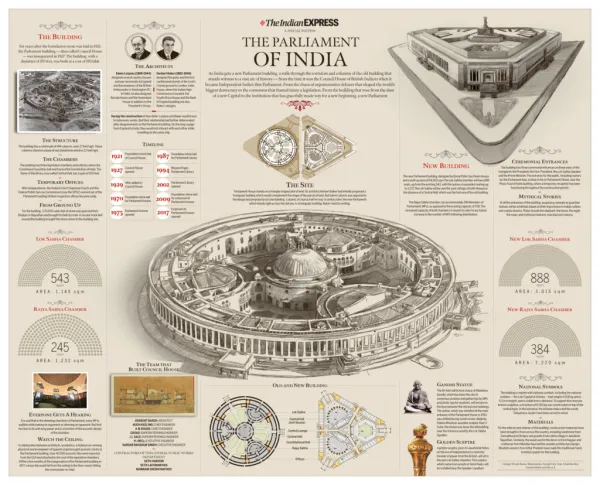
The new Parliament building houses a larger Lok Sabha hall with a capacity of up to 888 seats, and a larger Rajya Sabha hall with a capacity of upto 384 seats.

The Indian Express has won the 6th International Newspaper Design Competition’s Best of Show honour under the Best of Infographics category.

The winning infographic, titled ‘The Parliament of India’, was an in-depth look at the country’s old Parliament building, weaving in important dates, numbers, photographs, and detailed sketches. It was published ahead of the opening of the new Parliament building, inaugurated on May 28, 2023.

The infographic was designed by Bivash Barua, illustrated by Suvajit Dey, and included text by Chakshu Roy, Damini Nath, and Divya A.

“This is a clean and elegant execution, easy to read and follow, and the colour palette does not take the attention away from the topic,” the judges said.

Other winners of the 6th International Newspaper Design Competition included German newspaper Die Zeit under the Best of Page One, The Hindu under the Best of Sports Page category, and Hindustan Times under the Best of Double Spread.

Here is the infographic:

You can download the poster here

source/content: indianexpress.com (headline edited)

INTERNATIONAL: ARTS & CULTUR: Shabana Azmi to be honoured with ‘Freedom of the City of London Award’ at the UK Asian Film Festival, May 2024

On Tuesday 7th May at Somerville College, Oxford will celebrate the actress’s industry milestone following a screening at Phoenix Picturehouse of her pioneering film, Fire (1996).

Veteran Indian actress Shabana Azmi, will be honoured with the Freedom of City of London Award by the City of London Corporation, in recognition of her prolific contribution to Indian cinema and as a campaigner for women’s rights. The award presentation will be a part of the celebrations to mark her 50 years in the industry at this year’s UK Asian Film Festival – the world’s longest-running South Asian film festival outside the Subcontinent. The ceremony will take place on Friday 10th May at Guildhall, City of London.

One of the City of London’s ancient traditions, Freedom is believed to have begun in 1237 and enabled recipients to carry out their trade. As well as being nominated or applied for, the Freedom is also offered by the City of London Corporation to individuals as a way of paying tribute to their outstanding contribution to London or public life or to celebrate a very significant achievement. Other recent high-profile recipients include theatre entrepreneurs, Dame Rosemary Squire, Sir Howard Panter and Sir Cameron Mackintosh; former England and Arsenal footballer, Ian Wright; double Olympic gold medallist Tom Dean, MBE; and the UK’s Chief Medical Officer, Professor Sir Chris Whitty.

Boasting an illustrious career that spans over 160 films and stretches across independent, parallel and mainstream Hindi cinema as well as international projects, Azmi is the daughter of renowned poet, Kaifi Azmi, and stage actress. Shaukat Azmi. She graduated from the Film and Television Institute of India (FTII) in 1973 and made her debut with Shyam Benegal’s debut social drama Ankur in 1974, which won her the National Award for Best Actress.

Between 1983 and 1985 for three consecutive years, Azmi won the National Film Award for Best Actress for her performances in Arth, Khandhar and Paar. In subsequent years, she continued to soar to the heights of critical and commercial success, becoming one of the leading ladies of Indian parallel cinema, a new-wave movement of arthouse films recognised for their authentic and realistic storyline, treatment and sensibility.

Even when it came to mainstream films, Azmi dared to traverse beyond the glossy and stereotypical portrayals of women with impactful realistic performances in films like Masoom and Arth, pushing the boundaries further and inviting audiences to re-imagine the off-screen societal norms that dictated the on-screen representations of a housewife, mother and woman in an evolving Indian society.

Azmi is the winner of five National Film Awards and several international accolades and was honoured with the Padma Shri in 1998 and the Padma Bhushan in 2012 by the Government of India for her outstanding contribution to cinema. Unlike many of her peers who confined themselves to on-screen activism, throughout much of her life, Azmi has remained committed to fighting injustices, lending her powerful voice and on-screen persona to critical issues such as AIDS ostracism and child mortality amongst other causes. She has worked extensively with slum dwellers in Mumbai and was the President of Nivara Hakk, a housing rights NGO that provided houses for free to 50,000 people in Mumbai who were evicted from their homes. She heads the NGO, Mijwan Welfare Society (MWS), founded by her father, which works for the upliftment of rural India with a focus on the girl child and women. She has fought relentlessly against religious fundamentalism of all hues and is highly respected as a moderate, liberal Muslim voice.

Azmi’s remarkable contributions have been recognised on numerous prestigious platforms. She was awarded the Gandhi International Peace Prize at the House of Lords by Vanessa Redgrave and honoured at the Bicentennial celebrations of International Human Rights in Paris, alongside Mother Theresa, by President Mitterand of France. Additionally, Azmi received the Crystal Award at the World Economic Forum, with Mohammed Ali and Michael Douglas. She holds five Doctorates from renowned national and international universities and has been conferred with the prestigious Martin Luther King, Rosa Park, and Chavez Awards. Her recent nomination as Global Leadership Ambassador for Women in Public Service Project, initiated by Hillary Clinton, further underscores her global impact and commitment to fostering positive change. She has also been chosen by Time Magazine as one of 25 Asian heroes and is the only woman among four Indians who has made a difference.

Shabana Azmi says, “In anticipation of the esteemed Freedom of the City of London Award, I am deeply honoured. This recognition not only celebrates my contribution to cinema but also emphasises the intrinsic link between art and activism. I am humbled by this distinction and eagerly anticipate the chance to continue advocating for social causes through storytelling.”

UK Asian Film Festival Creative Director, Samir Bhamra says, “It is an honour to acknowledge the remarkable contributions of Shabana Azmi. From her pivotal role in inaugurating our festival in London to inspiring our celebration of her 50-year journey, Shabana Azmi epitomises resilience, advocacy and artistic brilliance. We stand proudly alongside her, recognising her unwavering dedication and support. Her upcoming recognition with the Freedom of the City of London award is a testament to her extraordinary achievements. UKAFF’s instrumental role in instigating this prestigious award underscores Shabana Azmi’s profound impact on the arts and society at large.”

As part of the festival programme, Celebrating The Golden Girl: Shabana Azmi on Tuesday 7th May at Somerville College, Oxford will celebrate the actress’s industry milestone following a screening at Phoenix Picturehouse of her pioneering film, Fire (India, 1996; Dir: Deepa Mehta; Language: English). The event and dinner will help raise funds to support the scholarship programme at The Oxford India Centre for Sustainable Development. Continuing the festival celebrations, the actress will be in conversation onstage following screenings of some of her cult and contemporary classics: Ankur (India, 1974; Dir: Shyam Benegal; Language: Hindi with English subtitles) on Wednesday 8th May at Khalil Lecture Room, SOAS, London; Mandi (India, 1983; Dir: Shyam Benegal; Language: Hindi with English subtitles) on Thursday 9th May at Phoenix, Leicester; and Rocky Aur Rani Kii Prem Kahaani (Idia, 2023; Dir: Karan Johar; Language: Hindi with English subtitles) on Thursday 9th May at Phoenix, Leicester.

Now in its 26th year, the UK Asian Film Festival, for which Azmi is a Patron, has historically championed South Asian female-centric cinema and women in film – both behind and in front of the camera.  Its programmes have annually sought to disrupt the patriarchal status quo and initiate challenging conversations in its mission to advocate and promote gender equality in cinema.

Running at venues across London, Leicester and Oxford from Thursday 2nd – Sunday 12th May, the UK Asian Film Festival is presented by Tongues on Fire and is supported by the BFI, awarding funds from the BFI Audience Projects Fund. UK Asian Film Festival is powered by broadcast partners, SONY TV and Lyca Radio. TV Partner for the UKAFF Short Film Competition is Shorts TV.

source/content: cineblitz.in (headline edited)