Author Archives: admin
India, U.S. ink 10-year defence framework pact
Rajnath Singh who met his American counterpart Peter Hegseth, says the pact will provide policy direction in the entire spectrum of the India-U.S. defence relationship.
India and the United States on Friday (October 31, 2025) inked a 10-year defence framework agreement, with Defence Minister Rajnath Singh describing it as a “signal” of growing strategic convergence between the two nations.
The pact was sealed at a meeting in Kuala Lumpur between Mr. Singh and his American counterpart Peter Hegseth.
The firming up of the pact came amid efforts by the two sides to repair ties that came under severe strain following Washington’s slapping of 50% tariffs on Indian goods.
“We signed the 10 years ‘Framework for the US-India Major Defence Partnership’. This will usher in a new era in our already strong defence partnership,” Mr. Singh said on X, formerly Twitter, after talks with Mr. Hegseth.
The Defence Minister said the pact will provide policy direction in the entire spectrum of the India-U.S. defence relationship.
“It is a signal of our growing strategic convergence and will herald a new decade of partnership,” he said.
“Defence will remain as a major pillar of our bilateral relations. Our partnership is critical for ensuring a free, open, and rules-based Indo-Pacific region,” Mr. Singh added.
Mr. Hegseth said the agreement “advances our defence partnership, a cornerstone for regional stability and deterrence.” “We’re enhancing our coordination, info sharing, and tech cooperation. Our defense ties have never been stronger,” he said.
Mr. Hegseth and Mr. Singh are in Kuala Lumpur to attend a meeting of a grouping of nations comprising ASEAN member states and some of its dialogue partners.
source/content: thehindu.com (headline edited)
Key API unit of Granules in Hyderabad gets VAI tag from U.S. FDA
Granules India’s active pharmaceutical ingredient Unit-1 in Bonthapally, Hyderabad, one of the largest single-site paracetamol API manufacturing plants by volume globally, has received U.S. Food and Drug Administration’s establishment inspection report with a voluntary action indicated (VAI) classification.
The U.S. FDA had issued one observation following an inspection of the facility in June. The company submitted its response within the stipulated time, the generic drugmaker said on Wednesday, announcing receipt of the EIR.
Along with Paracetamol APIs, the company has established Metformin and Guaifenesin API manufacturing plants in the same facility, it said. Granules shares closed less than 1% higher at Rs.571.25 apiece on the BSE.
“The successful completion of this U.S. FDA inspection and the subsequent receipt of the EIR with a satisfactory VAI classification reflects our commitment to maintaining the highest quality standards in manufacturing operations,” Chairman and Managing Director Krishna Prasad Chigurupati said in a release.
VAI is one of the three classifications the U.S. FDA issues, as part of the EIR, to determine the outcome of its inspection. VAI means objectionable conditions or practices were found, but the regulator is not prepared to take or recommend any administrative or regulatory action.
No action indicated or NAI is another classification, which means no objectionable conditions or practices were found during the inspection. The third category of classification is official action indicated (OAI) that means regulatory and/or administrative actions are recommended.
source/content: thehindu.com (headline edited)
Does Indian who won ₹240-crore UAE lottery pay taxes on it? It depends
The tax status of the 29-year-old Indian expat living in Abu Dhabi, identified as Anilkumar Bolla Madhavrao Bolla, would depend on where he pays taxes.
Among the chief questions in people’s minds after an Indian man won a massive lottery of 100 million dhirams — ₹240 crore — in the UAE recently were: if he has to pay any tax on it, and whether or not he can bring this to India.
The tax status of the 29-year-old Indian expat living in Abu Dhabi , identified as Anilkumar Bolla, would depend on where he pays taxes. There are no local UAE taxes on such lotteries, even when it’s the biggest such jackpot ever won in the country. So that means he gets all the money in his bank in the UAE.
In India, however, lottery prizes are taxed at a flat 30%, followed by a 15% surcharge on the tax amount (for winnings above ₹1 crore) and a 4% Health and Education Cess on the total, as per Mint. A person would be subject to this tax if he has resident status in India.
Resident/NRI rules matter
An individual will be treated as a resident in India in any previous year if he satisfies any of the following conditions, says the government : If he/she is in India for at least 182 days during the previous year; or for a period of 60 days or more in the previous year and overall 365 days during four years immediately preceding the previous year.
If he does not fall into either of these conditions, the lottery winner would have non-resident Indian (NRI) status, and not have to pay tax in India.
But if he has resident status, the following rule would apply as per the Directorate of Income Tax: “The total world income of a resident is liable to income tax in India… even if it is not received or brought into India.”
Anilkumar Bolla is a long-time Abu Dhabi resident who has lived in the UAE for over one and a half years, said a TOI report. That should mean he does not have to pay Indian taxes.
As to whether he can bring the lottery winnings to India – irrespective of tax status — the simple answer is in the negative.
According to the Reserve Bank of India (RBI) and the Foreign Exchange Management Act (FEMA), remitting lottery winnings to India is prohibited.
So here’s the simple breakdown:
- No tax in UAE
- No Indian tax if you have NRI status, depending on time spent outside India
- Indian tax will apply if considered ‘resident’, even if such income is not brought to India
- Lottery winnings anyway cannot be brought into India
What’s The UAE Lottery?
The UAE Lottery’s first-ever Dh 100 million jackpot is a record-breaking grand prize. The most recent draw was held on October 18 in which the jackpot number was 251018, and it made Bolla a multimillionaire after he matched all seven numbers in the exact winning combination, defying odds of 1 in 8.8 million.
Bolla told TOI his immediate plans are simple: “I plan to buy a supercar first and treat myself to a month-long stay at a seven-star hotel.”
source/content: hindustantimes.com (headline edited)
HAL to manufacture passenger jets with Russian firm that is under sanctions from US, UK, EU
The US Treasury has called Moscow’s public joint stock company UAC a key enterprise in Russia’s military-industrial complex. India has said it does not subscribe to unilateral sanctions.
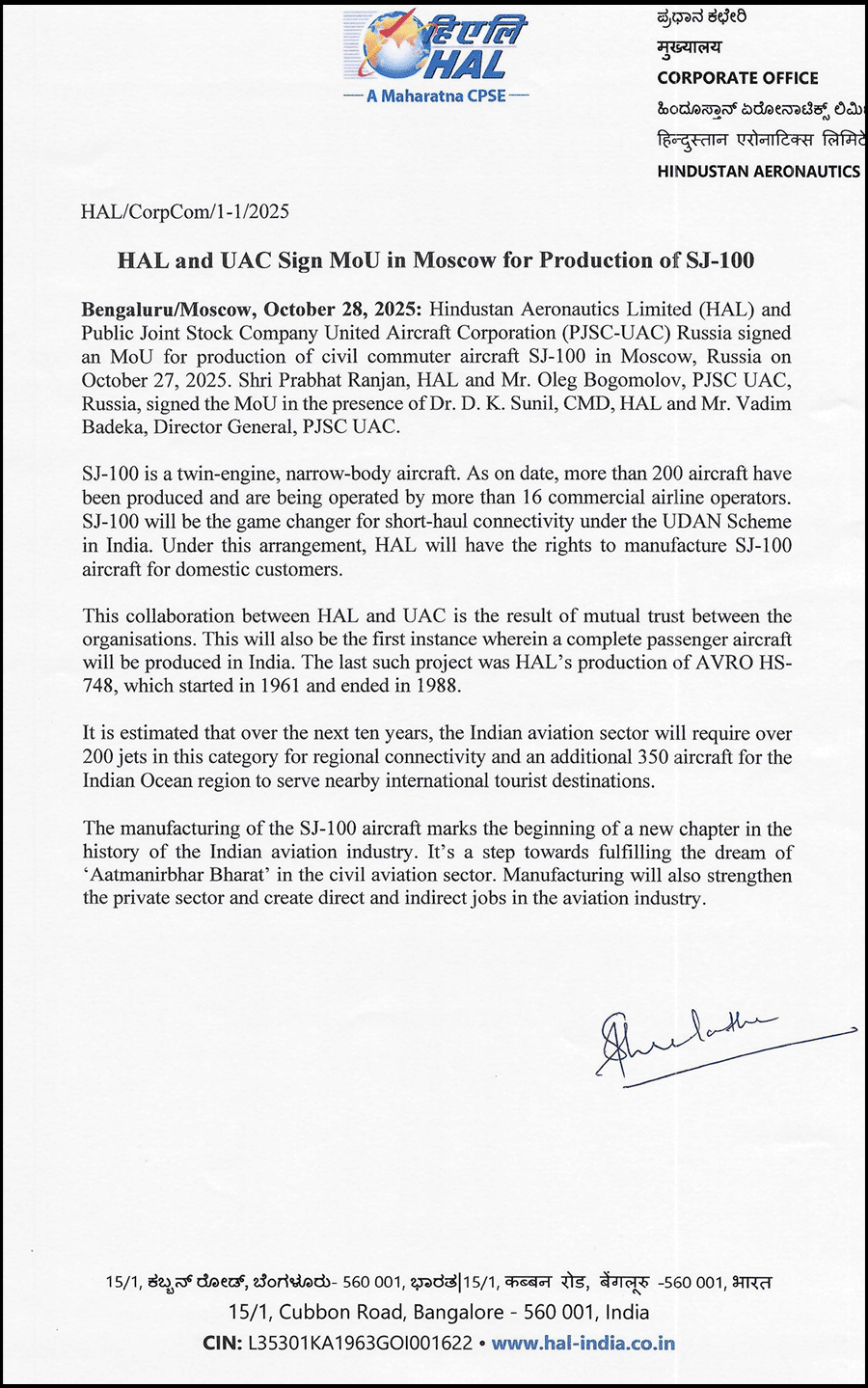
Hindustan Aeronautics Limited (HAL) on Tuesday signed a memorandum of understanding (MoU) with Russia’s United Aircraft Corporation (UAC), a company under US, UK and EU sanctions, for the joint production of the SJ-100 civil commuter aircraft.
“This will also be the first instance wherein a complete passenger aircraft will be produced in India. The last such project was HAL’s production of AVRO HS748, which started in 1961 and ended in 1988,” HAL said in a statement.
The SJ-100 is a twin-engine, narrow-body aircraft, and is in the fleet of around 16 commercial airlines. HAL said that SJ-100 will be the game changer for short-haul connectivity. Under this arrangement, HAL will have the rights to manufacture SJ-100 aircraft for domestic customers.
The joint venture was finalised a little more than a month before an expected visit to India by Russian President Vladimir Putin.
Russia’s public joint stock company UAC is under US, European Union, and British sanctions. The US treasury has called the firm a key enterprise in Russia’s military-industrial complex.
India has said it does not subscribe to unilateral sanctions and has criticised the targeting of its ties with Moscow as unjustified and unfair, while accusing the West of double standards because the EU and the US still buy Russian goods worth billions of dollars.
“This collaboration between HAL and UAC is the result of mutual trust between the organisations,” HAL said in a statement. “It’s a step towards fulfilling the dream of ‘Aatmanirbhar Bharat’ (self-reliant India) in the civil aviation sector.”
HAL has long partnered with the UAC, mainly by building under licence the Sukhoi Su-30MKI fighter jet for the Indian Air Force.
The collaboration is also expected to address India’s growing regional aviation demand. Estimates suggest that over the next decade, the country will require more than 200 jets in this category to support regional connectivity and an additional 350 aircraft for the Indian Ocean region to serve nearby international tourist destinations.
The agreement with United Aircraft Corporation marks a step towards producing a passenger aircraft in India for the first time, but risks stoking tensions with Western countries trying to punish Russia for its invasion of Ukraine.
source/content: telegraphindia.com (headline edited)
6th strain of Indian ancestry traced to Iran: Proto-Dravidian descent of Koragas dates back 4,400 years
The study by Das and his collaborators at Mangalore University and the University of Bern, Switzerland, found that the proto-Dravidian ancestry makes up around 20 per cent of the modern-day Indian genome.
Scientists studying a primitive tribe in India have uncovered a genetic signature previously unknown in Indian genomes that traces back to early Dravidian-speaking people from the Iranian plateau, roughly 4,400 years ago.
The findings have deepened the understanding of South Asia’s complex population history, adding a sixth ancestral source to India’s population genetic makeup — alongside South Asian hunter-gatherers, Neolithic Iranian farmers, Caspian steppe pastoralists, and Tibeto-Burman and Austroasiatic groups.
Multiple studies over the past two decades, seeking to explore the roots of modern populations, have shown that nearly all present-day Indians carry highly mixed ancestry, with varying proportions of genetic material from at least five ancestral populations.
Now, geneticists studying the Koragas, a primitive and vulnerable tribe native mainly to coastal Karnataka and Kerala, have identified a sixth ancestral component. They call it the proto-Dravidian ancestry, which appears to have emerged around the dawn of the Indus Valley civilisation.
“The Koragas were the key to this discovery — we found the proto-Dravidian ancestral component in them first,” Ranajit Das, a population geneticist and associate professor at Yenepoya University, Mangalore, told The Telegraph.
“But subsequent analyses show that it is present in other Indian populations as well.”
The study by Das and his collaborators at Mangalore University and the University of Bern, Switzerland, found that the proto-Dravidian ancestry makes up around 20 per cent of the modern-day Indian genome.
The proto-Dravidian ancestry is “distinct” from all other known ancestral components, the researchers said in a paper describing their findings published in the European Journal of Human Genetics on Friday. Mohammed Mustak, Jason Jeevan Sequeira and Swati Krishna in Mangalore and George van Driem in Berne were coauthors on the paper.
Earlier genetic studies had revealed that present-day Indians derive their ancestry from multiple populations that entered the subcontinent over tens of thousands of years.
The earliest were the South Asian hunter-gatherers, descendants of modern humans who had migrated out of Africa roughly 60,000 to 70,000 years ago.
Several Indian tribes, including those in the Andaman and Nicobar Islands, retain large portions of this ancient heritage.
The later waves included Neolithic farmers from the Iranian plateau, who arrived between 8,000 and 6,000 years ago and mixed with the South Asian hunter-gatherers.
They were followed 3,000 to 4,000 years ago by Caspian steppe pastoralists from the northwest. Additional contributions came from the Northeast, where Tibeto-Burman groups entered the region, and from Southeast Asia, which brought the Austroasiatic component.
The Koragas are among the oldest tribes in Karnataka’s Udupi and Dakshina Kannada districts and Kasargod in Kerala. Social scientists have documented their traditional occupations as basket-weaving and drum-beating.
Researchers believe that endogamy may explain the unusually high prevalence of multiple genetic diseases — congenital deafness, congenital retinal disease, congenital anaemia and several genetic neurological disorders — among members of the Koragas.
The discovery of the proto-Dravidian ancestral signature provides fresh evidence for the theory that the region between the Iranian plateau and the Indus Valley was a Dravidian heartland before the arrival of the Indo-European languages into thesubcontinent.
The Koragas speak a Dravidian language that, the researchers believe, is related to a set of north Dravidian languages. Brahui, spoken in Balochistan, is the only surviving north Dravidian language.
The results illustrate how studies on isolated population groups can show hidden ancestral signatures,” said Kumaraswamy Thangaraj, a scientist at the Centre for Cellular and Molecular Biology, Hyderabad, who was not associated with the study. Two decades ago, his CCMB team had shown that the Andaman and Nicobar tribes were descendants of the earliest modern humans to arrive in India from Africa — a finding that underscored the same principle.
source/content: telegraphindia.com (headline edited)
Late astrophysicist Jayant Narlikar, who challenged Big Bang theory, selected for Vigyan Ratna award
Narlikar challenged the Big Bang theory, which states that the universe was created in a single moment.
India’s most celebrated astrophysicist Jayant Narlikar, who passed away in May, was on Saturday selected for the Vigyan Ratna Puraskar.
Narlikar challenged the Big Bang theory, which states that the universe was created in a single moment. He, along with British astronomer Fred Hoyle, proposed that the universe had always existed with continuous creation of new matter into infinity.
Narlikar died on May 20 at the age of 86.
Modelled on the Padma awards, the Rashtriya Vigyan Puraskar is the country’s top science award. The winners for 2025, the second edition of the Rashtriya Vigyan Puraskar, were announced on the website of the national awards — awards.gov.in — on Saturday.
The government also announced eight Vigyan Shri, 14 Vigyan Yuva and one Vigyan Team awards.
Noted agriculture scientist Gyanendra Pratap Singh, popularly known as the wheat breeder, won the Vigyan Shri award for his contribution to the field of Agricultural Science.
Yusuf Mohammad Seikh, Director of the physics group of the Bhabha Atomic Research Centre, won the Vigyan Shri for his contribution to the field of Atomic Energy.
K Thangaraj of the Centre for Cellular and Molecular Biology has won the award in the field of Biological Sciences and Pradeep Thalappil of IIT-Madras bagged the Vigyan Shri in the field of Chemistry.
Aniruddha Bhalchandra Pandit, Vice Chancellor of the Institute of Chemical Technology, was awarded the Vigyan Shri in the field of Engineering Sciences and S Venkata Mohan, Director of National Environmental Engineering Research Institute, won the award in the field of Environmental Science.
Mahan Maharaj, a monk of the Ramakrishna Order and Professor of Mathematics at the Tata Institute of Fundamental Research, won the Vigyan Shri in the field of Mathematics and Computer Science.
Jayan N of the Liquid Propulsion Systems Centre has been selected for his contribution to Space Science and Technology.
The 14 Vigyan Yuva awardees are Jagdis Gupta Kapuganti (Agricultural Science), Satendra Kumar Mangrauthia (Agricultural Science), Debarka Sengupta (Biological Sciences), Deepa Agashe (Biological Sciences), Dibyendu Das (Chemistry), Waliur Rahaman (Earth Science), Arkaprava Basu (Engineering Sciences), Sabyasachi Mukherjee (Mathematics and Computer Science), Shweta Prem Agrawal (Mathematics and Computer Science), Suresh Kumar (Medicine), Amit Kumar Agarwal (Physics), Surhud Shrikant More (Physics), Ankur Garg (Space Science and Technology), and Mohanasankar Sivaprakasam (Technology and Innovation).
The CSIR Aroma Mission Team, which heralded the ‘Lavender Mission’ in Jammu and Kashmir, won the Vigyan Team award.
source/content: hindustantimes.com (headline edited)
IISER Kolkata’s Dibyendu Das wins prestigious ‘Vigyan Yuva Shanti Swarup Bhatnagar Award’
Chemical Sciences Associate Professor recognized for pioneering work in systems chemistry, exploring ‘Life 2.0’ and the origins of life.
Associate professor of Indian Institute of Science Education and Research, Kolkata, Dibyendu Das, has been selected for the prestigious ‘Vigyan Yuva Shanti Swarup Bhatnagar Award’ under the Rashtriya Vigyan Puraskar (RVP) 2025, officials said on Saturday.
Das, an associate professor in the department of chemical sciences, is internationally recognised for his pioneering contributions to the emerging field of systems chemistry, where his laboratory investigates how life-like functions can emerge from simple chemical building blocks.
His research addresses fundamental questions such as how living-matter-like materials can be artificially created, whether concepts of “Life 2.0” can be realised in the laboratory, and how chemistry can illuminate the origins of life.
Confirming the news, Das said, “It was scheduled to be announced on August 22, but was delayed for a few months.” An IISER Kolkata official said, “The award in chemistry for the year 2025 was announced by the government of India under the Rashtriya Vigyan Puraskar in recognition of Das’ pioneering discoveries, internationally acclaimed publications and leadership in shaping the rapidly growing discipline of systems chemistry.” The RVP is positioned as one of the highest recognitions in India for contributions in science, technology and technology-led innovation.
Earlier, IISER Kolkata faculty including Soumitro Banerjee (2003, Physical Sciences), Biswarup Mukhopadhyaya (2003, Physical Sciences), Swadhin Kumar Mandal (2018, Chemical Sciences), and Rahul Banerjee (2018, Chemical Sciences) were also conferred the Shanti Swarup Bhatnagar Award for their innovative work, officials said.
Except for the headline, this story has not been edited by The Telegraph Online staff and has been published from a syndicated feed.
source/content: telegraphindia.com (headline edited)
Hyderabad hospital launches genetic test; claims it helps doctors know which medicines work for you
Imagine a single test that can guide your doctor on which medicines will work best for your body, not just today, but for the rest of your life. AIG Hospitals, in collaboration with GenepoweRx, has launched an affordable pharmacogenomics test – which helps doctors prescribe medicines based on an individual’s genetic makeup.
Every person metabolises medicines differently. Some drugs that work well for one individual may be ineffective, or even harmful, for another. The pharmacogenomics test analyses a patient’s genetic code to predict how their body responds to common medications for heart disease , diabetes, cancer, gastrointestinal disorders, neurological and psychiatric conditions, and pain management.
The test is priced at ₹5,000, a fraction of the ₹80,000 charged for similar genomic tests in Western countries. The test results can be used anytime in the future. Patients receive a personalised report booklet, which can be shown to any doctor, anywhere, ensuring all future prescriptions are tailored to their genetic profile, said D. Nageshwar Reddy, chairman, AIG Hospitals.
The launch follows a joint study involving more than 2,000 patients, which revealed that nearly 30% were taking medicines that were not suited to their genetic makeup. In some cases, the dosage needed to be increased, while in others it needed to be reduced. The mismatch led to poor treatment outcomes or avoidable side effects.
How the test works?
A 2 ml blood sample is drawn at AIG Hospitals. DNA is extracted and analysed using sequencing technology on validated platforms such as Illumina and MGI. Approximately 5 GB of genomic data per patient is processed to determine how the body metabolises drugs across multiple disease pathways. The results are compiled in a report and delivered to the patient within 12–13 days, said Hima Challa, clinical genomics expert, Harvard Medical School, who is part of the project.
The test evaluates around 120–190 genes that influence drug metabolism. It is not disease-specific, instead, it provides a comprehensive profile of how an individual responds to medications for any condition. Even if a patient develops a new disease or is prescribed a new drug in the future, the information can guide correct dosing.
Data sources and research
The test uses a combination of AIG Hospitals’ own study of over 2,000 Indian patients and UK Biobank data, which includes about 15% Indian representation among a million participants. This ensures that genetic variations specific to the Indian population are considered before arriving at a decision.
Cost and benefits
“Beyond affordability, the test can reduce pharmaceutical costs by preventing over-prescription and unnecessary high dosages, while also avoiding complications and hospitalisations caused by adverse drug reactions,” said Dr. Reddy.
source/content: thehindu.com (headline edited)
Indian-origin Historian Sunil Amrith wins British Academy Book Prize
The 46-year-old’s latest book, described by judges as “important reading” in the context of the climate crisis, received the coveted prize at a ceremony at the British Academy in London on Wednesday evening.
‘The Burning Earth: An Environmental History of the Last 500 Years’ by Indian-origin historian Sunil Amrith has been named the winner of this year’s British Academy Book Prize, a prestigious 25,000-pound award that celebrates the world’s best works of non-fiction.
Amrith, a Professor of History at Yale University in the US, was born in Kenya to South Indian parents, grew up in Singapore and graduated from the University of Cambridge in England.
The 46-year-old’s latest book, described by judges as “important reading” in the context of the climate crisis, received the coveted prize at a ceremony at the British Academy in London on Wednesday evening.
“I’ve sometimes been asked whether ‘The Burning Earth’ is a bleak book,” said Amrith, via live video link from the US. There’s no doubt it details a great deal of harm and suffering, both human and environmental, and it shows that the two were almost always interlinked.
But in the end, what I’d like to read from the book is a sense that many parts brought us to this point of time.
So there were also many paths not taken, ideas that have been forgotten, movements that may have failed but have left a lasting legacy, technologies that were humbler and more sustainable.
“And perhaps we can find, in returning to those paths not taken, seeds of inspiration for a more hopeful and less violent way of living together on this planet, which we share with each other and with so much other life that we depend on,” he said.
The announcement was made by the chair of the judges, UK-based historian Professor Rebecca Earle, who described the winning work as a magisterial account of the interconnections between human history and environmental transformation.
“It is vivid in detail and beautifully written important reading for anyone seeking to understand the origins of today’s climate crisis,” said Earle.
“Amrith is a remarkable scholar whose global perspective reveals the impact of the environment on human history, as well as our impact on the environment.
In fact, as he shows, it’s not really possible to separate these two. It is never an easy task to choose one winner from an exceptional shortlist of six, but our panel agreed that ‘The Burning Earth’ exemplified the spirit of the prize: to deepen understanding of our world,” she said.
The British Academy, the UK’s national academy for the humanities and social sciences, notes that Amrith’s ground-breaking work of global environmental history draws on decades of meticulous and eye-opening research to reveal how colonisation, industrialisation and the shifting patterns of human settlement have not only shaped the modern world but also fuelled the climate crisis we are now faced with.
Spanning continents and centuries from the conquest of the Americas to British gold mining in South Africa, from the Black Death to the Second World War, Amrith takes the reader on an epic journey, offering a new perspective on humanity’s impact on the planet.
“This fresh look at the interplay of human history with the shape of the earth combines rigorous research with page-turning prose.
It is precisely the combination of evidence-informed insight, well-honed ideas, and great writing that we are proud to celebrate through our annual international book prize,” said Professor Susan J Smith, President of the British Academy.
The other five shortlisted works, which each receive 1,000 pounds, included ‘The Golden Road: How Ancient India Transformed the World’ by William Dalrymple; ‘The Baton and The Cross: Russia’s Church from Pagans to Putin’ by Lucy Ash; ‘Africonomics: A History of Western Ignorance’ by Bronwen Everill; ‘Sick of It: The Global Fight for Women’s Health’ by Sophie Harman; and ‘Sound Tracks: A Musical Detective Story’ by Graeme Lawson.
The British Academy Book Prize was established in 2013 to reward writing grounded in exceptional research in the fields of the humanities and social sciences.
To be eligible for the prize, books must be works of non-fiction published in the UK, with authors of any nationality, based anywhere in the world and working in any language, provided that the nominated work is available in the English language.
source/content: newindianexpress.com (headline edited)